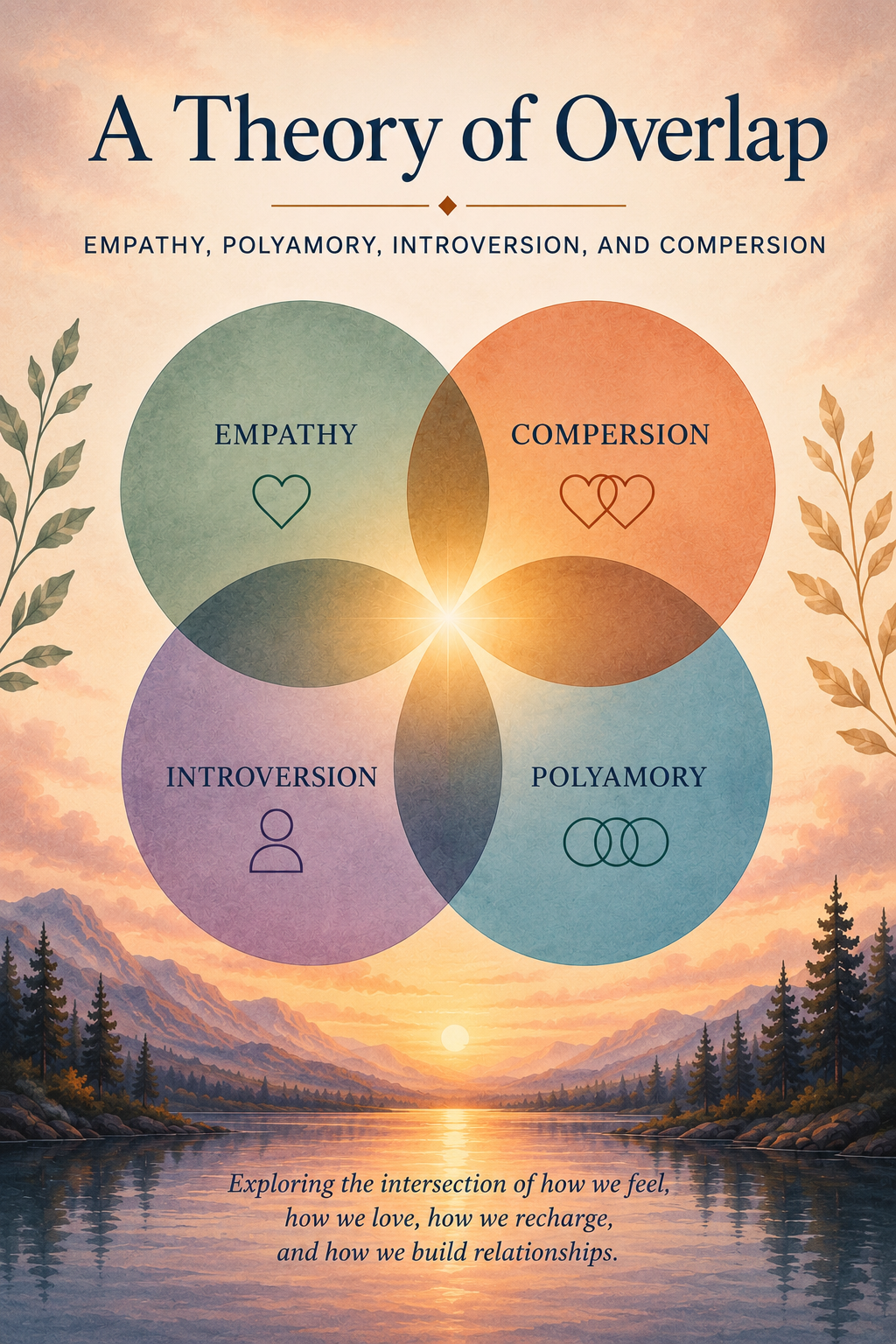
A Theory of Overlap: Empathy, Polyamory, Introversion, and Compersion
Opening
Over the years, I’ve noticed a pattern.
In the personal scenes that follow, I use pseudonyms and soften identifying details out of respect for the autonomy and privacy of the people whose lives intersect this question. The emotional pattern is mine to examine; their identities are not mine to make public.
Many of the polyamorous people I’ve known seem to share a set of traits that, at first glance, do not obviously belong together. They are often attentive to other people’s inner lives. They notice tone, timing, hesitation, longing, fear, and relief. Many can feel some form of happiness when a partner is happy with someone else. Many are also quieter than the stereotypes about polyamory would predict: socially selective, easily saturated by emotional intensity, and more interested in depth than volume.
The pattern did not begin as a revelation. It accumulated as a series of small relational weather changes I kept noticing. A room would shift when another partner was mentioned. Someone would make space for a bond that did not include them without making that bond disappear. A partner would absorb new information, breathe, and stay present instead of treating another connection as an immediate threat. I kept seeing people listen as if emotional complexity were not an emergency.
That observation is not evidence by itself. It is a reason to ask a question.
The question is whether empathy, polyamory, introversion, and compersion meaningfully overlap, or whether I have mistaken the shape of my own social world for a broader pattern. Maybe I am noticing a real cluster. Maybe visible polyamorous spaces reward emotional fluency, so the people easiest to see are the people most comfortable discussing feelings, boundaries, jealousy, and autonomy. Maybe introversion is not central at all. Maybe the pattern is better explained by openness, secure attachment, social class, queer community norms, therapy language, online discourse, or my own selective attention.
I want to take the pattern seriously without protecting it from correction.
I am not trying to prove that the overlap exists.
I am trying to find the most accurate explanation the evidence can support, even if that explanation is less elegant than the one I began with. That distinction matters to me because the original pattern is personally resonant. It would be easy to write toward recognition and call that recognition truth. I do not want to do that.
So I am keeping several kinds of claims separate. Some come from inspected evidence. Some are calculations from documented values. Some are modeled assumptions used only to test scale where direct evidence is missing. Some are my own observations or interpretations. Those categories can speak to one another, but they cannot substitute for one another. A personal observation can motivate the inquiry. It cannot answer it.
My first exposure to ethical non-monogamy did not immediately answer the question. In Dallas in the early 2000s, much of what I encountered was closer to swinging, couple swapping, sexual openness, or consensual cross-couple interaction. I did not react against it. I also did not feel especially called by it. It seemed organized primarily around sexual access, and that was not where the emotional charge lived for me.
Then I started noticing an adjacent subset that felt different. It was less sex-centric, more openly affectionate, harder to map into clean couple-units, and more emotionally permeable. Public affection did not always identify the primary relationship. Another bond could enter the room without everyone pretending it was secondary or unreal. When I visited Elias and Nora, for example, I was not struck by polyamory as an abstract structure. I was struck by how Elias's wider relational context existed beside his mostly monogamous relationship with Nora, and by the subtle ways the emotional field changed when another partner or metamour entered conversation or space. What caught my attention was not spectacle. It was room: room made for another attachment point, another truth, another person.
That combination kept catching my attention because it resisted two common stereotypes. The first stereotype treats polyamory as a high-social-volume life: more partners, more dates, more negotiation, more social exposure, more people. The second treats introversion as a retreat from relational complexity. If both stereotypes were true, introverted polyamory would look like a contradiction. But in the people I was noticing, the opposite seemed possible. The same people who needed solitude could also care intensely about multiple emotionally significant relationships. The same people who were easily saturated by social noise could be unusually patient with emotional complexity.
That raised the question I’ve been unable to shake:
Are these traits merely coexisting by coincidence, or are they expressions of a deeper underlying disposition?
I don’t know the answer.
What I do know is that the question has become more complicated the longer I have looked at it. Empathy is not one thing. Compersion is not the simple opposite of jealousy. Polyamory is not identical to all forms of consensual non-monogamy. Introversion is not shyness, fear, or disinterest in people. Each term becomes blurrier the closer I get to it, and that blurriness does not make the question worthless. It makes the question more honest.
I began by wondering whether four circles overlap. I still think that is the right starting point. But I no longer think the best answer will be a clean diagram where each circle has a stable border and the center can be measured like a fixed population. The evidence supports some parts of the intuition, weakens others, and leaves important gaps. It suggests possible relationships without proving a single cause. It also reminds me that a pattern can be personally meaningful and still not be a population pattern.
So this essay stays close to that tension. I am writing from inside a recognizable experience, but I am not treating recognition as proof.
Section 1: Defining the Four Circles
Before I can ask whether the circles overlap, I have to be careful about what I mean by each circle.
Empathy is the first term that seems obvious until I try to define it. In ordinary conversation, people use empathy to mean kindness, emotional sensitivity, compassion, agreement, social attunement, and sometimes the painful experience of absorbing everyone else’s feelings. Those uses overlap, but they are not the same. The distinction that matters most here is between cognitive empathy and affective empathy. Cognitive empathy is perspective-taking: the ability to understand another person’s point of view, inner logic, or emotional situation. Affective empathy is emotional resonance: some felt echo of what another person is feeling.
Those two capacities can travel together, but they can also separate. A person can understand someone else’s perspective without feeling much emotional resonance. Another person can feel the atmosphere in a room before they can explain what they are sensing. Compassion sits nearby, but it is not identical either. Compassion adds care, concern, or a wish to reduce suffering. Curiosity sits slightly farther out. It can draw a person toward understanding another inner world, but curiosity by itself is not empathy. A person can be curious without being kind. A person can be accurate without being caring.
For this essay, when I talk about empathy, I mean a family of related capacities: perspective-taking, emotional resonance, concern for another person’s experience, and the desire to understand what an experience means from the inside. I do not mean that every empathic person has all of those capacities in equal measure. I also do not mean that empathy is automatically ethical. Empathy can be selective. It can be inaccurate. It can become intrusive if it ignores boundaries. It can even become a way of centering oneself in another person’s experience. Still, some combination of noticing, understanding, and caring is central to the pattern I am trying to examine.
Compersion is the second circle, and it is even more delicate.
Compersion is often described as the opposite of jealousy. That definition is memorable, but it is too clean. Jealousy is not a single emotion, and compersion is not simply the absence of it. I understand compersion as positive emotional participation in another person’s happiness, fulfillment, intimacy, or connection. It can be happiness because someone else is happy. It can be warmth toward a relationship that nourishes a person I love. It can be pleasure in watching someone become more alive in a context that does not revolve around me. It can be the quiet realization that another bond does not automatically diminish my own.
The important part is that compersion and jealousy can coexist. If I feel joy for a partner and fear at the same time, the joy is not fake. If insecurity appears beside tenderness, tenderness has not been disproven. Human emotions rarely arrive one at a time. In polyamorous contexts especially, a partner’s joy with someone else may touch several systems at once: generosity, comparison, autonomy, attachment, fear, curiosity, gratitude, grief, pride. Treating compersion as the pure opposite of jealousy flattens all of that. It also turns compersion into a test of enlightenment, which is not useful and can become cruel.
There is another boundary I want to keep clear. Attachment security may make compersion easier to access, but that does not mean security is itself compersion. A secure person may feel less threatened by a partner’s other connection. That lower threat may create more room for happiness. But the room and the happiness are not the same thing. This matters because I am trying to avoid building the overlap out of terms that secretly contain one another. If compersion already includes security, and security already includes autonomy, and autonomy already includes non-possessive love, then the model becomes circular. I want the concepts to touch without collapsing into a single word.
Polyamory also needs narrowing. I am not using it as a synonym for every form of consensual non-monogamy. Sexually open relationships, swinging, casual non-monogamy, relationship anarchy, and broader sex-positive communities can overlap with polyamory, but they do not all ask the same emotional questions. The version that matters here is emotionally significant polyamory: the practice, acceptance, or pursuit of multiple consensual romantic relationships where emotional connection, relational investment, and ongoing significance matter.
That focus is intentional. The question that drew me in was not simply whether someone can have sex with more than one person ethically. It was whether a person can sustain multiple emotionally meaningful bonds without interpreting each bond as a threat to the others. Sex may be part of that. It may not. The emotional architecture is the point.
For me, sex is not the driver of the question. It is one possible expression of affection, longing, closeness, and depth. The version of polyamory that caught my attention was not organized around sexual access. It was organized around emotional significance.
Introversion is the fourth circle, and it is the easiest to misread.
I am not using introversion to mean shyness, social anxiety, misanthropy, emotional coldness, poor social skill, or dislike of people. Those can overlap with introversion, but none defines it. The familiar energy-and-recovery shorthand is not a complete scientific definition, but it is useful for the lived pattern I am describing: social interaction often costs energy, while solitude often restores it. An introvert may love intimacy, conversation, community, and partnership while still needing substantial time alone to recover and think.
That distinction matters because polyamory is often imagined as a high-output social life. More partners must mean more people, more events, more dating, more talking, more emotional labor, more availability. Sometimes it does. But that is not the only shape polyamory can take. A person can have limited social appetite and deep relational capacity. A person can be selective without being avoidant. A person can want fewer shallow interactions and more honest ones.
Once I define the circles this way, the original question becomes more precise. I am not asking whether kind, outgoing people are more likely to date multiple people. I am asking whether people who are emotionally attuned, capable of non-competitive joy, drawn to emotionally significant non-monogamy, and selective about social energy may cluster in ways that are not obvious from any one trait alone.
Section 2: Empathy and Compersion
The first possible overlap felt intuitive: empathy and compersion.
Compersion looks empathy-like because it involves another person’s emotional life becoming meaningful from the inside. When someone I love is happy and I feel warmed by that happiness, I have noticed the joy, allowed it to matter, and felt some part of my own emotional state move in response.
I do not think I learned that movement from polyamory. I think polyamory gave me a place to notice what empathy had already been doing in me for years. As a child, animals were emotionally vivid to me, and people's embarrassment or pain could feel immediate enough to require action. In the early-to-mid 1990s, around theater, I remember seeing a boy harassing a girl and feeling her embarrassment before I had language for why it mattered. I intervened because I could feel enough of what she was feeling that neutrality did not seem available.
But compersion is not just ordinary happiness-for-another-person. It becomes sharper when the happiness comes from a relationship that could, under a different story, be interpreted as competition. A partner’s joy with a friend is one thing. A partner’s joy with another romantic partner may touch desire, replacement, value, uniqueness, time, sex, priority, and belonging. The empathic movement is happening in a more charged field.
That is why I do not think compersion can be reduced to empathy. Empathy may help create the conditions for compersion, but it does not guarantee it. I can understand why something matters and still feel afraid, care about someone’s happiness and still wonder whether I am losing something, resonate with a partner’s joy and still feel the old animal panic of comparison.
The difference becomes clearer when I think about Mara and Rowan. When they were dating, I felt real compersion for Mara. I was genuinely happy for her happiness. The fear was not primarily, "Does her joy mean less love for me?" It was more practical and more existential: what happens if this takes root? What changes in daily life, for me, for Mara, for everyone attached to this new reality? The fear was that real joy changes real lives.
With Selene, the emotional field has been different so far. I have not experienced another romantic bond of hers as competition, in part because I am not currently aware of one and trust that she would tell me. What I have felt is gratitude for the richness already in her life: her roommate relationship, her friendships, the people she loves, the emotional world that shaped her before I arrived.
The evidence fits that caution. It points toward a relationship between empathic capacities and compersion, especially through perspective-taking and emotional understanding, but it does not make empathy the whole mechanism. Attachment anxiety, envy, insecurity, communication, relationship quality, metamour familiarity, and whether a person’s own needs feel seen and met all matter. Mindfulness complicates the picture too: noticing jealousy without being consumed by it may create space for compersion even when empathy is not the main driver.
This changed how I think about the first pair of circles. Compersion might involve empathy, but it cannot be reduced to empathy. Perspective-taking may help me imagine why a partner’s other relationship matters. Emotional resonance may help me feel some of their happiness. Compassion may make that happiness worth protecting rather than dismissing. None of those capacities removes the rest of the emotional field.
The more honest conclusion is partial. Empathy and compersion touch, but compersion is not simply empathy wearing a polyamorous outfit. It is a more specific emotional capacity shaped by empathy, security, context, relationship quality, and practice in ways the current evidence cannot yet fully separate.
Section 3: Empathy and Introversion
The link between empathy and introversion is where the model first becomes fragile.
Personally, I find the connection plausible. If social environments carry more emotional information for some people, then being around others may require more processing. A conversation is tone, timing, facial tension, withheld reactions, shifting attention, small disappointments, sudden brightness, and the emotional weather of everyone involved. If a person registers much of that, even a pleasant interaction can become dense.
In that frame, solitude is not rejection. It is digestion.
That is how the pattern feels from the inside. After enough emotional input, I do not always need fewer people because I dislike people. I need quiet because my mind is still sorting what happened: which feelings are mine, which belong to someone else, and which emerged only because several people were in the same room at the same time.
One of the clearest examples was a team dinner in Santa Cruz. There were maybe twenty or thirty people there, including partners. I had invited partners because they support the people I work with, and because I do not experience a team as only the employees listed on an org chart. I remember looking down the table at happy faces: coworkers talking, partners integrating, small groups forming and dissolving, the whole social system functioning beautifully. Later, outside, a few people waited for Ubers and there was spontaneous salsa dancing. Nothing was wrong. That was the point. Sometimes I need solitude not because the room harmed me, but because the room gave me too much beauty to carry all at once.
When I say I feel full after something like that, I mean it physically. There is pressure in my chest, pressure in my head, and sometimes fogginess before I can tell what the experience means. The fog is not the destination. It is the weather before integration. First comes emotional input. Then pressure. Then solitude or simple movement. Then the complexity starts to settle and clarity returns.
Recovery is not always stillness. Sometimes it is mowing the yard, cuddling my dog, or going for a drive. A simple physical task occupies the part of me that needs motion while another part walks back through the emotional room. What was mine, and what was not?
This is also why I reread texts. I am not usually looking for proof or reassurance. I am trying to feel the parts of the conversation I could not inhabit while I was busy being myself. That can become overanalysis if I am not careful. Curiosity can become a bridge, but if I build it too fast, I stop standing in the room with the person.
I can make sense of that. I cannot yet treat it as a strong empirical claim.
The evidence supports several nearby points, but not the whole bridge I first wanted to build. Empathy is multidimensional. Introversion is distinct from shyness and social anxiety. Personality evidence links empathy more consistently with traits such as agreeableness and conscientiousness than with a simple introversion-extroversion split. Solitude preference can arise from restoration, autonomy, anxiety, creativity, sensory sensitivity, or simple preference. Introversion does not explain all of those.
So this part of the model has to become smaller. It is reasonable to ask whether high emotional attunement makes social life more expensive for some people, or whether repeated emotional labor encourages stronger boundaries. But I cannot say that highly empathetic people are generally more likely to be introverts. I also cannot say that introversion is evidence of high empathy.
The distinction matters because this essay is not helped by forcing every circle to overlap equally. If empathy and introversion connect only for a subset of people, that may still describe a lived path by which some people become socially selective: not because they lack interest in others, but because interest itself has a cost. The available support gives me a narrower claim: empathy may help explain some introverted behavior for some people, especially when emotional processing is costly. Beyond that, the claim stays provisional.
Section 4: Compersion and Polyamory
The relationship between compersion and polyamory is stronger than the relationship between empathy and introversion, but it is still easy to overstate.
Polyamory does not require compersion. I want to say that plainly because compersion can become a badge people feel pressured to display. A polyamorous person can feel jealousy, insecurity, comparison, grief, anger, dread, tenderness, and generosity in the same hour. A relationship can be ethical and loving without anyone feeling spontaneous joy about a partner's other romantic life. If compersion becomes mandatory, it stops being an emotion and becomes a performance of security. It can teach people to treat jealousy as failure, fear as immaturity, or reassurance as evidence that they are not polyamorous enough. I do not want a theory of overlap to become another way to rank people by emotional sophistication.
At the same time, compersion clearly matters in polyamorous contexts. It appears in work on consensual non-monogamy, relationship maintenance, jealousy, metamour dynamics, and relationship satisfaction. It is associated with secure attachment, communication, needs being met, metamour familiarity, and positive regard for a partner's other relationships. It is also shaped by envy, attachment anxiety, insecurity, unclear agreements, and relational uncertainty. That does not settle causality. People with a stronger capacity for compersion may be more likely to explore or remain in polyamory. Polyamory may also give people repeated opportunities to cultivate compersion. Both may be true.
The best conclusion is bounded. Compersion is not universal in polyamory, and it is not a requirement for ethical non-monogamy. But it is highly relevant to how some polyamorous people understand, sustain, and emotionally navigate their relationships. It names a real possibility inside relational life: that a partner's joy with someone else can sometimes be felt not as subtraction, but as something worth appreciating.
That possibility may be blocked by insecurity, neglect, scarcity, poor communication, or genuine incompatibility. It may be available only after trust has been built and needs have been named. But the fact that compersion is conditional does not make it imaginary. Trust, forgiveness, desire, patience, and generosity all depend on context. Compersion appears to belong in that family.
Section 5: Introversion and Polyamory
The assumed conflict between introversion and polyamory may be more cultural than logical.
If polyamory is imagined as constant dating, negotiation, social exposure, and a large visible network of partners and metamours, introversion looks like a poor fit. That version would be exhausting for many introverts, and for many people who do not call themselves introverts. But emotionally significant polyamory does not have to mean maximum social volume. It may involve fewer relationships than outsiders imagine: deeper, slower, more explicit, and more emotionally demanding, but not necessarily more socially crowded. The question is what kinds of connection feel worth the energy they require.
From the inside, introverted polyamory does not feel contradictory to me. It feels selective. It asks whether a relationship is meaningful enough to deserve the attention, care, time, and recovery it will require. It does not confuse abundance with volume. It can look like a small number of serious bonds, each held with explicitness, and a strong need for alone time between emotionally intense encounters.
This is one reason the stereotype misses something important. Polyamory can be socially demanding, but it can also be structurally honest about demands that monogamy sometimes hides. Time has to be named. Desire has to be negotiated. Jealousy cannot always be absorbed into the assumption of exclusivity. For an introvert who prefers depth and explicitness, that visibility can be difficult but clarifying.
I have lived both the expansion and the cost. Before COVID, especially in my thirties, my life held more dating, coaching, teaching private lessons, and deep student and aerialist connections. It was not shallow, but it was a lot. Current work can create a similar drain: I have built a team that is neurodivergent, queer, meaningfully representative of women, and unusually harmonious for how much intensity it holds. Supporting that team can still wipe me out. Some days I need solitude because I have no self left available to understand with.
Sometimes I am full and need processing. Sometimes I am depleted and need restoration before processing is possible.
Too much relational volume does not always mean too many people. Sometimes it means constant input without coherent depth. Nadia taught me that in a painful way. The problem was not simply that there were many demands. It was that the demands produced noise without mutuality: random inputs, constant action, disruption, caretaking, and attention without the deeper reciprocity that lets complexity become meaningful.
The evidence remains thin. Current personality findings do not show that polyamory requires extroversion. The better-supported signals point elsewhere: openness, conscientiousness, ambiguity tolerance, and attitudes toward consensual non-monogamy. There is not yet a strong public evidence base showing that introverts are overrepresented in polyamorous communities.
So I have to keep the claim modest. Introversion and polyamory are not opposites. Polyamory does not require extroversion, and introversion does not prevent deep relational multiplicity. But the stronger claim, that introverts are especially likely to be polyamorous or that polyamorous spaces are disproportionately introverted, remains mostly observational. It may be true in some communities, including mine, or it may be an artifact of who I know, where I spend time, or which forms of polyamory I recognize as emotionally serious.
What changed for me here is that I stopped asking whether introversion causes polyamory. That question now feels too blunt. The better question is how introversion shapes practice once some people are there: pacing, disclosure, partner selection, conflict style, recovery needs, and the difference between wanting multiple relationships and wanting constant availability.
Section 6: The Center of the Venn Diagram
If the four circles overlap, I do not think the center should be treated as a personality type, diagnosis, moral category, or identity badge. I am not trying to define a better kind of polyamorous person. I am trying to describe a pattern that may exist in some people, including people who would never name it this way.
The center, if it exists, begins with a particular kind of attention.
A person near that center may be unusually interested in other people's inner worlds. They may want to know what an experience feels like from someone else's side, what need sits underneath a reaction, what story someone is telling themselves, and what context is missing. Agreement is not the first goal. Understanding is. They may still disagree, set boundaries, leave, or say no. But they often want to understand the emotional logic before deciding what to do.
That attention can be beautiful. It can also be tiring. Other people's feelings do not remain abstract. Grief, excitement, fear, relief, longing, and joy can register in the body before they become conscious thought. I think this is part of why some highly empathic people seem socially selective. It is not that they do not care. It is that they care in a way that has a cost.
The center also includes relational curiosity. I do not mean curiosity as gossip or novelty-seeking. I mean the desire to understand how connection works. Why did that moment hurt? Why did that kindness matter so much? What did this relationship make possible? What did it ask from each person? What pattern keeps repeating? What is the difference between a need, a fear, a boundary, and a strategy?
That kind of curiosity can make polyamory feel less like chaos and more like a complex system. Not an easy system, and not a system one can control, but a system with feedback, pressure, incentives, histories, and recurring failure modes. Some people experience that complexity as too much. Others experience it as difficult but legible. They may not want drama, but they do want truth. They may not want constant negotiation, but they would rather name a tension than live inside an unspoken one.
The healthier version of this pattern includes boundaries. That is not optional.
Empathy without boundaries can become self-erasure. Compassion without self-regard can become overextension. Perspective-taking can become a habit of explaining away harm. Emotional resonance can become overwhelm. Relational curiosity can become analysis without action. The center of the overlap, if it exists, is not unlimited availability. It is selective, bounded care.
I learned some of that through failure. In one earlier relationship, I could understand her pain, explain her reactions, and empathize with what had shaped her. I could talk with Mara about what was happening while it was happening. But understanding became a trap when it kept me from being honest about my own harm. Empathy made me fluent in her pain before it made me honest about mine. Eventually I had to name the things I had looked away from, including the things that should have been deal breakers. That boundary felt harsh at the time. Later, it felt like self-respect.
Nadia taught the lesson differently. Early on, when need appeared, part of me recognized a healthy boundary: I can have compassion for this without needing to solve it. This is not mine to fix. But Mara's empathy has a nurturing flavor, and she felt moved to help. Then I felt empathy for Mara's desire to help. I also felt something like compersion for Mara's emotional experience of helping. A chain formed: Nadia presented need, Mara wanted to nurture, I wanted to support Mara's nurturing, and my own red flag got overridden. I mistook proximity to need for the beginning of intimacy.
The body knew the cost before the story became clear. When I realized my empathy had misread the situation, I felt intense pressure across my shoulders, neck, and upper torso, not exactly crushing but constant, like carrying a mattress over my head that rested on my shoulders. It was there when I woke and when I went to bed. It began to subside only after Nadia and her children left the house. My empathy was not wrong because it felt nothing. It was wrong because it felt something real and then misnamed what that feeling meant.
This is where introversion matters to me. The introverted version of the pattern is not a person with infinite relational capacity. It is a person who may care deeply and still need to be careful about how much contact, intensity, novelty, and ambiguity they can metabolize. Their limits are not evidence of insufficient love. Their solitude is not evidence of disconnection. It may be part of how they remain available for the relationships that matter.
The center also seems to involve a non-competitive view of love. I am using that phrase carefully. I do not mean that time, attention, money, energy, and practical care are infinite. They are not. Polyamory does not abolish scarcity. Calendars still exist. Exhaustion still exists. Neglect still hurts. What may be less competitive is the meaning assigned to love itself. A partner's affection for someone else does not automatically mean there is less affection available to me. Another bond may raise real questions, but it does not necessarily violate the idea that love can be plural.
That is where compersion becomes visible. A person near the center may feel happiness that a partner feels loved. They may feel warmth toward a metamour who treats a partner well. They may appreciate a relationship that gives someone something they themselves cannot provide. They may enjoy seeing a partner become more fully themselves in a context that is not organized around them.
None of this requires the absence of jealousy. In fact, if a theory of compersion cannot survive jealousy, it is too fragile for real life. The more useful question is whether joy can exist alongside fear, insecurity, or comparison. Can the nervous system make room for both? Can I say, "I am afraid," without needing to destroy the thing that makes you happy? Can I say, "I am happy for you," without pretending I have no needs of my own?
Selene made that question physical for me. When she told me she loved me, she did it with autonomy. She did not ask me to say it back. She did not demand certainty. She did not make her feeling my responsibility. She simply told me where she was emotionally. That mattered because it carried love without possession.
When I processed it with Mara, she did not push me toward the feeling or pull me away from it. She did not tell me what to feel. She did not try to resolve the uncertainty for me. She made it safe enough for me to discover whether the feeling was mine. What I found was not an absence of love. I felt love pressing against a lid.
The feeling had a location: the left side of my chest, near the sternum, with pressure at the right edge of that same left-chest space. It felt like shaking a soda bottle before opening it. Love was not missing. It was pressurized. It was rising, but blocked by the old fear that something too good to be true must be waiting to reveal the truth that would invalidate it. Nadia had taught my nervous system to expect betrayal beneath apparent love. With Selene, I had to decide whether fear would get veto power over love forever.
Mara and Selene do not occupy the same place in me. Mara sits slightly farther outward from Selene's point, still on the left side of my chest but farther from the sternum. The image that comes closest is mechanical: each love is like a large cable bolted onto my heart with five hex bolts. The cables are conduits. They carry feeling in and out. They ebb and flow depending on the interaction. They are distinct, but they are not sealed away from one another. They have separate attachment points on the same heart.
The center is also quieter than stereotypes suggest. It may not look like a big network, public sexuality, constant dates, or a social calendar full of partners. It may look private, reflective, and selective. It may look like a small number of serious relationships and a lot of recovery time. It may look like someone who dislikes shallow social performance but craves emotional truth. It may look like someone slow to open but intensely present once they do.
This is the part of the pattern I recognize most strongly: the refusal to treat depth and multiplicity as opposites. A person can need solitude and still want more than one emotionally significant bond. A person can be cautious with social energy and still love in a way that is not organized around exclusivity. A person can reject ownership without rejecting commitment.
But there is a shadow version, and it matters.
The same traits that make deep relational openness possible can become costly when poorly bounded. Perspective-taking can become over-explaining other people's harm. Emotional resonance can become taking responsibility for feelings that are not one's own. Relational curiosity can become compulsive analysis. Compassion can become self-abandonment. Compersion can become pressure to perform security before it is actually felt. Introversion can become withdrawal rather than recovery. Polyamory can become a structure where complexity is tolerated long after clarity was needed.
The deeper danger is not complexity itself. It is the failure to integrate complexity. In the earlier relationship, I understood her pain but did not integrate my own harm. With Nadia, compassion, Mara's nurturing, my red flags, and the actual imbalance all existed at once, but one truth overwhelmed the others. With Selene, love and fear both existed; integration meant fear stopped vetoing love. With Mara, safety did not mean permission. It meant enough stability for integration to happen.
That shadow keeps me from romanticizing the center of the diagram. If the overlap exists, it describes a possible capacity, not automatic maturity. It does not guarantee ethical behavior. It does not guarantee secure attachment. It does not protect anyone from jealousy, avoidance, poor boundaries, or harm. A person can be empathic and still manipulative. A person can be polyamorous and still possessive. A person can be introverted and still avoidant. A person can speak beautifully about compersion and still use it to silence someone else's pain.
So the center is not a destination. It is a question about how several capacities might combine, and what happens when they combine well or badly.
Section 7: Measuring the Overlap
At some point, the question becomes quantitative whether I want it to or not. If these four circles overlap, how large might the overlap be? Are we talking about a common but undernamed pattern, a small subculture, a rare combination of traits, or a shape that feels large only because I happen to stand near it?
No direct population-level evidence currently answers that question. I cannot report an empirical prevalence rate for the four-way overlap because the evidence does not measure the four-way overlap. The best I can do is a scale test: if the documented values and the explicitly modeled assumptions were true, what size would the overlap imply?
The current model uses an introversion estimate informed by public self-identification data, a modeled high-empathy value, a modeled value for emotionally significant polyamory, and a modeled conditional value for compersion capacity among people in emotionally significant polyamory. Each choice matters. Broad definitions make the overlap larger. Narrow ones make it smaller. If traits cluster positively in real life, the model may underestimate the overlap. If the definitions are partly incompatible, or if the same people would not actually meet all four thresholds at once, the model may overestimate it.
Under the current sensitivity model, the overlap ranges from about 14 people per 100,000 in the conservative scenario, to about 119 per 100,000 in the moderate scenario, to about 539 per 100,000 in the aggressive scenario.
Because the model multiplies rough estimates and modeled assumptions, the resulting numbers should be read as scale intuition, not demographic evidence. They do not say, "This is how many people are like this." They say, "If we define the terms this way, and if these assumptions are reasonable, the possible scale falls somewhere in this range." That is weaker, but more honest.
The model also changed my intuition. Before doing the calculation, the overlap felt familiar enough that I could imagine it being large. The scale test made that feeling less trustworthy. Even when each circle seems recognizable, the center can become small quickly. Four meaningful traits do not need to be rare individually for their intersection to be uncommon.
That does not make the overlap unimportant. Small patterns can matter. Rare combinations can shape communities, relationships, language, and self-understanding. But it does make me more cautious about treating my personal environment as representative.
The better metaphor may be an iceberg. The overlap may be small in surface perception, not because there is little there, but because most of what matters is below the surface. A modeled estimate can make the visible part look small. It cannot measure the depth of the internal experience: the integration, the energy cost, the embodied attachment points, the way one person becomes a meeting place for multiple emotional truths.
The calculation is useful only because it is humble. It converts a vague intuition into a transparent question, then shows where the evidence is missing: a better operational definition of high empathy, better measurement of emotionally significant polyamory, better evidence about compersion capacity, and direct evidence about whether these traits actually cluster.
Section 8: Counterarguments and Alternative Explanations
The strongest challenge to this essay is that the pattern may not be a population pattern at all.
It may be a selection effect. Polyamorous spaces often attract people who are willing to discuss emotions, boundaries, attachment, autonomy, communication, jealousy, and desire explicitly. That does not mean all polyamorous people are unusually empathic. It may mean the people most visible in certain spaces are the ones most comfortable using that vocabulary. If I spend time around people who process relationships out loud, I should not be surprised when I notice emotional fluency.
It may be a visibility effect. People who experience compersion may be more likely to talk about it because it is interesting, affirming, or identity-relevant. People who struggle quietly with jealousy, scarcity, or insecurity may be less visible, even if they are just as much part of polyamorous life. If the people who speak most often about compersion are the people who have access to it, then compersion may look more common than it is.
It may be a language effect. Communities teach people how to describe themselves. Therapy language, queer community norms, online discourse, education, politics, and social class can all shape who enters visible polyamorous spaces and what words they use once they arrive. A pattern that looks psychological may partly be cultural. People may learn to describe relational complexity through the language available to them, and that language may make some traits easier to see than others.
It may be a measurement effect. The terms in this essay are not equally measurable. Introversion has several frameworks. Empathy has multiple dimensions. Polyamory can be defined broadly or narrowly. Compersion is still an emerging construct with uneven measurement. When the instruments are uneven, the overlap can appear or disappear depending on how the terms are operationalized. A model can only be as good as the definitions it inherits.
It may be explained by personality traits other than introversion. The evidence currently points more clearly toward openness, conscientiousness, ambiguity tolerance, and attitudes toward consensual non-monogamy than toward introversion itself. If those traits explain more of the pattern, then introversion may be secondary. It may describe how some people experience the overlap, not why the overlap exists.
It may also be explained by attachment security. If secure attachment makes autonomy feel less threatening, then security could help explain both the ability to tolerate a partner's other bonds and the ability to experience compersion. In that case, empathy might still matter, but it would not be the central mechanism. The key variable might be whether love feels secure enough to allow difference, distance, and plurality without immediate panic.
There is also a possibility that I find uncomfortable because it is so ordinary: maybe I am noticing compatibility among my own people. Communities are not random samples. Friend groups are not datasets. The people who remain in one's life often share values, communication styles, political assumptions, neurotypes, language habits, and tolerances for complexity. A pattern can be real locally and still fail as a general claim.
My own history makes that warning necessary. The early Dallas scene did not all fit the pattern I am describing. Much of it was sexual, social, sometimes symmetrical, sometimes asymmetrical, and not necessarily organized around the emotional depth that later caught my attention. That does not make it invalid. It means this essay is not about all ethical non-monogamy. It is about the emotionally significant subset that made me ask a different question.
The lived experience of polyamory also resists any overly elegant theory. Evidence from polyamorous participants describes real challenges: time management, stigma, jealousy, emotional demands, communication, disclosure, legal recognition, representation, insecurity, dating, and cost. Those difficulties do not disprove overlap. They do weaken any version of the theory that makes polyamory sound naturally effortless for empathic or compersive introverts.
That matters because the most tempting version of the argument is also the least trustworthy: empathetic people understand others, compersive people enjoy others' joy, introverts prefer depth, polyamory allows multiple deep bonds, therefore these traits naturally belong together. The sentence is elegant. It is also too smooth. It hides the friction that makes relationships real.
Time is friction. A person can believe love is not scarce and still have only so many evenings in a week. Energy is friction. A person can feel deeply for several people and still become depleted. Social stigma is friction. A person can be secure in a relationship and still suffer from invisibility, misunderstanding, or lack of legal recognition. Attachment is friction. A person can endorse autonomy and still feel afraid when a partner turns toward someone else. Communication is friction. A person can value honesty and still fail to know what they need until after harm has occurred.
These counterarguments do not destroy the original question. They improve it. They force me away from "these four traits go together" and toward something more careful: what combination of traits, circumstances, skills, histories, and communities makes the overlap visible?
They also remind me that a good explanation should survive the cases that complicate it. If the theory only works for people who are already secure, articulate, resourced, and surrounded by supportive communities, then the theory is not about polyamory in general. It is about one favorable version of it. That may still be worth describing, but it must be named honestly.
Section 9: An Emerging Alternative Model
The four-circle model remains useful, but I no longer think it is the best final explanation.
That realization came late. I did not begin by asking about a broader relational orientation. I began with four circles: empathy, polyamory, introversion, and compersion. I wanted to know whether they overlap more often than chance would suggest. That is still a meaningful question. But the more carefully I handled the evidence, the less stable the borders became.
Curiosity may be less a dimension of empathy than a facilitator of empathic understanding. Compassion may be closely related to empathy without being identical to it. Secure attachment may be less a form of compersion than a condition that makes compersion easier to access. Introversion may not drive polyamory so much as shape the way some people experience emotionally significant relationships. Openness, conscientiousness, ambiguity tolerance, communication norms, community language, and relationship security may all be doing more work than the original diagram allowed.
This does not make the original question useless.
It makes the question more interesting.
The overlap may not be a place where four independent traits simply happen to coexist. It may point toward a broader relational orientation: a way of moving through intimacy shaped by perspective-taking, emotional resonance, relational curiosity, autonomy, attachment security, ambiguity tolerance, and a non-competitive view of love.
In that model, the four circles remain meaningful, but they become surface expressions of something deeper. Empathy names the attention to another person's inner world. Compersion names the possibility that another person's joy can become emotionally positive even when it does not center the self. Polyamory names one relationship structure where non-possessive love becomes explicit and consequential. Introversion names one way this orientation may regulate energy, depth, and exposure.
The deeper pattern might be this: a person can care deeply without wanting ownership, seek intimacy without wanting constant social exposure, experience another person's joy as meaningful, and tolerate relational complexity without needing it to become simple.
The overlap is not where complexity disappears. It is where complexity becomes coherent.
That sentence feels closer to the pattern I was trying to describe. It also makes the uncertainty clearer. If the deeper pattern is real, then the four circles are not equal causes. They are different windows into a larger orientation toward intimacy, autonomy, emotional resonance, and complexity. Some people may share that orientation without being polyamorous. Some may be polyamorous without sharing it. Some may be extroverted rather than introverted. Some may experience compersion rarely but still value non-possessive love. The model becomes less tidy, but more humane.
It also becomes harder to measure. A broad relational orientation cannot be counted by multiplying four rough estimates. It would need better definitions, better instruments, and direct evidence designed to distinguish a real population cluster from a local, cultural, or community-specific pattern. It would need to ask whether the same underlying factors appear across different communities, relationship structures, and levels of visibility.
So I am left with a revised conclusion. The four-circle model is a useful doorway. It helped me find the question. It helped me notice where the evidence was strong, where it was weak, and where my intuition was doing too much work. But the better explanation may not be that empathy, polyamory, introversion, and compersion simply overlap. The better explanation may be that they sometimes reveal a broader way of relating: emotionally attentive, autonomy-respecting, depth-seeking, complexity-tolerant, and cautious about turning love into ownership.
I thought I was studying four traits. At some point, I realized I was studying the conditions under which complexity becomes coherent. Compersion may be empathy when there is enough safety for another person's joy to stop reading as threat. Introversion may be the environment where emotional experience becomes incorporated rather than merely remembered as fact. Polyamory may be one structure where multiple emotional truths become explicit instead of remaining theoretical. Empathy may be the attention that notices those truths in the first place.
That model is still provisional. It may be wrong. It may be too influenced by the communities I know and the language I use. But it now seems more accurate than the simpler hypothesis that motivated the essay.
Closing
Perhaps there is no overlap at all.
Perhaps empathy, polyamory, introversion, and compersion are more independent than my experience makes them feel. Perhaps the pattern I noticed is mostly coincidence, selection bias, community language, or the ordinary fact that people tend to recognize themselves in people like them.
Or perhaps there really is a region where the four circles intersect, but it is smaller, less trait-like, less introversion-specific, and more dependent on relationship context than my first observation suggested.
I think that second possibility still matters, but I hold it differently now. I no longer see the overlap as a proof waiting to be demonstrated. I see it as a question that became more honest under pressure.
The original intuition was not wrong exactly. It was incomplete. Empathy seems relevant to compersion, but it does not explain compersion by itself. Introversion may shape how some people experience relational depth, but it does not appear to be the main personality signal in the evidence. Polyamory creates contexts where compersion can matter, but it does not require compersion and does not become effortless for people who feel deeply. The center of the diagram may exist, but it is not automatically healthy, secure, or common.
What remains is quieter and more useful to me.
Some people seem able to care deeply without wanting ownership. Some seek intimacy without wanting constant exposure. Some can experience another person's happiness as meaningful even when it does not place them at the center. Some are willing to live with relational complexity, not because complexity is easy, but because simplicity purchased through denial costs too much.
For me, solitude is not the emotional center of that pattern. Integration is. Solitude matters because it is often where integration happens. It is where love and fear, empathy and boundaries, Mara and Selene, compersion and uncertainty, intellectual analysis and embodied knowing can sit in the same room without one truth being forced to erase another.
I do not know how many people live there.
I do not know whether the pattern is a measurable population cluster, a community-shaped language, a personal recognition, or some mixture of all three. I only know that the shape feels familiar, and that familiarity is no longer the conclusion. It is the beginning of the question I can now ask more carefully.
It feels like sitting alone while everything settles into place inside me, realizing that love can have more than one attachment point on the same heart.
Appendix A: Research Summaries
One page per topic.
For each source:
- Key findings.
- Sample size.
- Geography.
- Methodology.
- Strengths.
- Weaknesses.
- Confidence rating.
Appendix B: Calculations and Assumptions
Purpose
To provide a transparent, reproducible workbook of all calculations, assumptions, and derivations supporting the overlap estimate.
Workbook Rules
- All derived values must be traceable to source IDs listed in Appendix C.
- Raw values and derived estimates must be clearly separated.
- Confidence and rationale must be stated for each estimate.
- Sensitivity notes must be included for all key calculations.
- Values from Limited sources may inform framing but must not be treated as publication-ready evidence without disclosure.
- Every active source must be classified by contribution type before it is used in prose or modeling.
- A source may strengthen the essay without being eligible for the quantitative model.
Evidence Contribution Classes
Each active source is assigned a primary role. Appendix C preserves the individual audit record; this section explains how the sources enter the investigation.
- Observed prevalence or frequency evidence: INT-001, INT-003, EMP-004, POLY-001, POLY-002, CNM-001, OPEN-001. These sources provide reported percentages, but only some match the constructs needed by the model.
- Measurement, construct, or scale evidence: INT-004, INT-005, EMP-001, EMP-002, EMP-003, EMP-005, EMP-006, COMP-001, COMP-004, COMP-009, COMP-010. These sources define or measure constructs; most do not provide prevalence.
- Construct-boundary and definition evidence: INT-002, INT-006, POLY-003, COMP-018. These sources prevent overbroad definitions and keep the essay from confusing related constructs.
- Personality, attitude, and association evidence: EMP-007, POLY-007, CNM-005, PERS-001. These sources complicate simple introversion or empathy explanations by pointing toward agreeableness, conscientiousness, openness, ambiguity tolerance, and CNM attitudes.
- Relationship-functioning and contextual evidence: POLY-004, POLY-005, POLY-008, CNM-002, CNM-003, CNM-004, POLY-006, POLY-009, COMP-002, COMP-003, COMP-005, COMP-006, COMP-007, COMP-008, COMP-011, COMP-012. These sources support, complicate, or contextualize the narrative but do not directly measure the four-way overlap.
- Theoretical or philosophical framework evidence: COMP-013, COMP-014, COMP-015, COMP-016, COMP-017. These sources clarify possible interpretations of compersion; they are not prevalence evidence.
Model inclusion is narrower than source inclusion. INT-001 and INT-003 inform the introversion sensitivity range. POLY-001, POLY-002, CNM-001, and OPEN-001 inform the scale of broader non-monogamy and polyamory-adjacent behavior, but the essay's current polyamory value remains modeled because none directly measures current emotionally significant polyamory. EMP-004 is preserved as an observed comparison point but is not used as the high-empathy model value because its definition does not match the essay's operational target. No verified source currently supplies a population value for compersion capacity.
Source Weighting Rubric
- Evidence quality
- Question: Is this peer-reviewed, representative, and methodologically clear?
- Suggested weight impact: 0.00–0.30
- Sample size
- Question: Is the sample large enough to support the estimate?
- Suggested weight impact: 0.00–0.20
- Recency
- Question: Is the data recent enough to reflect current social behavior?
- Suggested weight impact: 0.00–0.15
- Construct validity
- Question: Did the source measure the construct this essay actually needs?
- Suggested weight impact: 0.00–0.25
- Scope match
- Question: Does the source match the essay’s scope?
- Suggested weight impact: 0.00–0.10
Introversion Workbook
Source IDs: INT-001, INT-002, INT-003, INT-004, INT-005, INT-006
Source Records
- INT-001
- Raw value: 38%
- Meaning: Self-identified as completely introverted or more introverted than extroverted
- Sample size: 999
- Geography: US
- Year: 2023
- Method: Online survey
- Value type: Observed survey response
- Notes: Not a Big Five assessment; total is 9% + 29%
- INT-002
- Raw value: N/A
- Meaning: Introversion did not consistently predict solitude preference or self-determined motivation for solitude
- Sample size: 183 and 270 undergraduate participants
- Geography: US
- Year: 2022
- Method: Two daily diary studies
- Value type: Contextual relationship evidence
- Notes: Supports caution around equating introversion with solitude preference
- INT-003
- Raw value: 44%
- Meaning: Self-identified as introvert in binary introvert/extrovert question
- Sample size: 996
- Geography: US
- Year: 2016
- Method: Online survey
- Value type: Observed survey response
- Notes: Not a Big Five assessment; binary wording likely inflates comparison with INT-001
- INT-004
- Raw value: N/A
- Meaning: BFI-S formal Big Five assessment is usable in large-scale survey panels, with caveats for telephone interviewing and older adults
- Sample size: 19,351 SOEP participants in 2005; 13,459 retest/stability participants; 1,200 related CATI survey participants
- Geography: Germany
- Year: 2011
- Method: Open-access psychometric validation using representative German samples
- Value type: Measurement framework
- Notes: Formal trait measurement context; does not give an introversion prevalence rate
- INT-005
- Raw value: N/A
- Meaning: National-sample extraversion scores were mostly stable across adulthood; older adults were slightly lower in extraversion, but age effects were small
- Sample size: 10,063 NHANES I follow-up respondents; 654 ABLSA comparison participants
- Geography: US
- Year: 1986
- Method: National probability follow-up study using neuroticism, extraversion, and openness survey measures
- Value type: Measurement and stability evidence
- Notes: Formal trait measurement context; no introversion cutoff or prevalence
- INT-006
- Raw value: N/A
- Meaning: Shyness and sociability are conceptually and empirically orthogonal; shyness is not interchangeable with low sociability
- Sample size: 24 selected high/low-shyness participants from an initial 152 undergraduate students
- Geography: Canada / undergraduate sample
- Year: 2014
- Method: Event-related fMRI, cortisol awakening response, and sociability measures
- Value type: Construct-distinction evidence
- Notes: Supports separating introversion, shyness, and sociability; no prevalence
Derived Estimate
- Weighted moderate estimate: 38%
Confidence: Medium
Rationale: Uses verified public YouGov surveys for self-identification, an open-access diary-study source to avoid overclaiming what introversion means, two formal trait-measurement sources to distinguish self-labeling from trait-scale assessment, and one construct-distinction source to keep introversion separate from shyness and sociability. The prevalence value still does not measure formal Big Five extraversion/introversion and should not be generalized beyond self-labeling.
Sensitivity Notes: Range for sensitivity now uses 30% (conservative) to 44% (aggressive). The aggressive bound is traceable to a second public YouGov self-identification poll, but the whole range remains limited by self-labeling rather than formal trait measurement.
High Empathy Workbook
Source IDs: EMP-001, EMP-002, EMP-003, EMP-004, EMP-005, EMP-006, EMP-007
Source Records
- EMP-001
- Raw value: N/A
- Meaning: IRI multidimensional empathy framework
- Sample size: 677 male and 667 female undergraduates
- Geography: US
- Year: 1983
- Method: Psychometric scale development
- Value type: Measurement framework
- Notes: Public full-text mirror inspected; no prevalence
- EMP-002
- Raw value: N/A
- Meaning: QCAE cognitive/affective empathy framework
- Sample size: 640 exploratory; 318 confirmatory; 925 complete QCAE responses across studies
- Geography: UK / Europe-heavy sample
- Year: 2011
- Method: Psychometric scale development
- Value type: Measurement framework
- Notes: Public author-uploaded full-text mirror inspected; no prevalence
- EMP-003
- Raw value: N/A
- Meaning: Empathy measures review; 50 studies and 23 instruments assessed
- Sample size: Review
- Geography: International
- Year: 2021
- Method: Systematic review/meta-analysis
- Value type: Review evidence
- Notes: Public full text inspected; no prevalence
- EMP-004
- Raw value: 55%
- Meaning: EU27 respondents classified as high empathy under a five-item emotional-empathy scale
- Sample size: Nearly 13,000
- Geography: EU27; deeper samples in Belgium, France, Germany, Italy, Netherlands, Poland, Spain
- Year: 2020
- Method: Representative public opinion survey
- Value type: Observed survey classification
- Notes: Incompatible with top-quartile model; high means above average on this survey's scale
- EMP-005
- Raw value: N/A
- Meaning: Empathy Quotient score distribution and sex differences in nonclinical samples
- Sample size: 90 controls; 197 general-population volunteers
- Geography: United Kingdom
- Year: 2004
- Method: Scale development and group comparison
- Value type: Measurement and distribution evidence
- Notes: Public PDF inspected; small volunteer/control samples; not representative prevalence
- EMP-006
- Raw value: N/A
- Meaning: Large EQ/SQ dataset showed empathy and systemizing as normally distributed dimensions and reported Type E / Extreme Type E frequencies
- Sample size: Discovery n=671,606 including 36,648 autistic people; validation n=14,354 including 226 autistic people
- Geography: Online, mostly UK / Channel 4 recruitment
- Year: 2018
- Method: Large online self-report study using short EQ/SQ/AQ/SPQ forms and D-score brain-type classification
- Value type: Distribution and measurement evidence
- Notes: Type E means EQ greater than SQ, not high-empathy prevalence; self-selected online sample
- EMP-007
- Raw value: N/A
- Meaning: Big Five associations with empathy were broadly similar across four countries; agreeableness and conscientiousness were more central empathy predictors than extraversion
- Sample size: China n=438; Germany n=304; Spain n=62; US n=92
- Geography: Cross-national convenience samples
- Year: 2016
- Method: EQ, IRI, and Big Five correlation/regression study
- Value type: Personality-association evidence
- Notes: Supports caution around a simple empathy-introversion/extroversion story; no prevalence
Derived Estimate
- Moderate estimate: 25% (operationalized as top quartile)
Confidence: Low
Rationale: Verified public sources support multidimensional empathy measurement, cognitive/affective empathy measurement, small-sample empathy-score distributions, one very large EQ/SQ online distribution study, and cross-national personality-association context. EMP-004 provides an observed "high empathy" classification in an EU public-opinion survey, EMP-005 provides Empathy Quotient score ranges, and EMP-006 provides Type E / Extreme Type E brain-type frequencies, but none are used as the essay's prevalence estimate because their definitions and samples do not match a top-quartile cognitive-plus-affective trait profile. The 25% value remains a modeled operational assumption.
Sensitivity Notes: Range for sensitivity: 15% (conservative) to 35% (aggressive).
Derived essay value: E = 0.25 (MODELED VALUE)
Emotionally Significant Polyamory Workbook
Source IDs: POLY-001, POLY-002, POLY-003, POLY-004, POLY-005, POLY-006, POLY-007, POLY-008, POLY-009, CNM-001, CNM-002, CNM-003, CNM-004, CNM-005, OPEN-001, PERS-001
Source Records
- POLY-001
- Raw value: 10.7%
- Meaning: Previous engagement in polyamory, single adults
- Sample size: 3,438
- Geography: US
- Year: 2021
- Method: Census-based quota sample
- Value type: Observed survey response
- Notes: Lifetime engagement; not current prevalence
- POLY-001
- Raw value: 16.8%
- Meaning: Desire to engage in polyamory, single adults
- Sample size: 3,438
- Geography: US
- Year: 2021
- Method: Census-based quota sample
- Value type: Observed survey response
- Notes: Interest/desire only
- POLY-001
- Raw value: 6.5%
- Meaning: Knows someone who is or has been engaged in polyamory
- Sample size: 3,438
- Geography: US
- Year: 2021
- Method: Census-based quota sample
- Value type: Observed survey response
- Notes: Familiarity measure
- POLY-002
- Raw value: 4%
- Meaning: Current open relationship, US adults
- Sample size: 2,270
- Geography: US
- Year: 2018
- Method: National probability sample
- Value type: Observed survey response
- Notes: Open relationships broader than polyamory
- POLY-002
- Raw value: 8%
- Meaning: Current nonconsensual nonmonogamy, US adults
- Sample size: 2,270
- Geography: US
- Year: 2018
- Method: National probability sample
- Value type: Observed survey response
- Notes: Not CNM; retained only to preserve distinction
- POLY-003
- Raw value: N/A
- Meaning: Lay definitions of polyamory emphasize relationship behaviors, multiple relationships/feelings, emotional, sexual, and ethical aspects
- Sample size: 463 valid answers
- Geography: Portuguese-speaking web survey
- Year: 2021
- Method: Qualitative thematic analysis
- Value type: Definition evidence
- Notes: Supports scope/definition, not prevalence
- POLY-004
- Raw value: N/A
- Meaning: Relationship satisfaction and attachment security differed across hierarchical and non-hierarchical polyamorous configurations
- Sample size: Study 1 n=225; Study 2 n=360
- Geography: Online polyamory samples; exact geography not extracted
- Year: 2021
- Method: Two-sample comparative study of relationship satisfaction and attachment security
- Value type: Relationship-structure evidence
- Notes: No prevalence; author manuscript publicly inspected
- POLY-005
- Raw value: N/A
- Meaning: Polyamorous participants showed relationship-specific attachment patterns; avoidance/anxiety affected quality within a given relationship but not another concurrent relationship
- Sample size: 357 people with at least two concurrent romantic partners
- Geography: Online community sample; exact geography not extracted
- Year: 2019
- Method: Community sample study of attachment with multiple concurrent partners
- Value type: Attachment and relational-functioning evidence
- Notes: No prevalence; author manuscript publicly inspected
- CNM-001
- Raw value: 21.9%; 21.2%
- Meaning: Lifetime CNM engagement in two samples of single adults
- Sample size: 3,905; 4,813
- Geography: US
- Year: 2017
- Method: Population-based cross-sectional surveys using census-based quota samples
- Value type: Observed survey response from public full-text mirror
- Notes: Broader than polyamory; context only
- CNM-002
- Raw value: N/A
- Meaning: Scoping review synthesized 209 empirical studies on polyamory and CNM across seven major research domains
- Sample size: 209 studies
- Geography: Primarily North America and Europe
- Year: 2023
- Method: Scoping review using Academic Search Complete, PsycInfo, ProQuest, Scopus, PubMed, follow-up search, and hand-search
- Value type: Review evidence
- Notes: Useful for field scope and gaps; not prevalence
- CNM-003
- Raw value: N/A
- Meaning: Meta-analysis found no overall relationship- or sexual-satisfaction advantage for monogamy over non-monogamy
- Sample size: 35 studies; N = 24,489
- Geography: Mostly Western study base
- Year: 2025
- Method: Meta-analysis of relationship satisfaction and sexual satisfaction by relationship orientation
- Value type: Meta-analytic relationship-outcome evidence
- Notes: Not a prevalence source; treats non-monogamy broadly
- OPEN-001
- Raw value: 2.4%; 4.0%; 19.6%; 12%
- Meaning: Current, lifetime, and ideal open relationship status
- Sample size: 2,003
- Geography: Canada
- Year: 2019
- Method: Nationally representative online survey
- Value type: Observed survey response from public full-text mirror
- Notes: Open relationships broader than polyamory; context only; CIs available for current and lifetime values
- POLY-006
- Raw value: N/A
- Meaning: Polyamorous participants named strengths including emotion management, compersion and/or low or well-managed jealousy, communication, challenging mononormativity, prior learning, resources, and financial privilege
- Sample size: 63 US-based adults with current or prior polyamorous relationship experience
- Geography: US
- Year: 2026
- Method: Qualitative thematic analysis of open-ended survey responses
- Value type: Strengths and resilience evidence
- Notes: Supports center/counterargument sections; no prevalence
- POLY-007
- Raw value: N/A
- Meaning: Public abstract reports polyamorous participants scored higher on openness, risk taking in social/ethical domains, and ambiguity tolerance, and lower on conscientiousness
- Sample size: 258 participants, including 119 polyamorous participants
- Geography: Not extracted from public abstract
- Year: 2024 / 2025 issue
- Method: Comparative Big Five, risk-taking, and ambiguity-tolerance study
- Value type: Limited personality-context evidence
- Notes: Abstract-only verification; does not publicly establish introversion or extroversion prevalence
- POLY-008
- Raw value: N/A
- Meaning: Polyamorous men and women reported greater intimacy than monoamorous counterparts; polyamorous men also reported stronger attitudinal and behavioral sociosexuality
- Sample size: Survey n=390; main men/women comparison n=284
- Geography: Mostly online polyamory and chain-referral recruitment; Canada/Ireland author teams, exact participant geography not extracted
- Year: 2013 / online 2011
- Method: Convenience-sample comparison of relationship well-being and sociosexuality
- Value type: Relationship well-being and sociosexuality evidence
- Notes: Not prevalence; source is relevant context but not a personality or overlap source
- POLY-009
- Raw value: 72.6%; 48.0%; 35.2%; 27.4%; 21%; 15%; 10%; 9.1%; 8.7%; 7.3%; 5.5%
- Meaning: Reported challenges among current polyamorous relationship participants, including time management, stigma, jealousy, emotional demands, communication, disclosure, legal recognition, lack of representation, insecurity, dating, and financial burden
- Sample size: 219 current polyamorous relationship participants; 763 open-ended responses
- Geography: Online sample; exact participant geography not extracted from this pass
- Year: 2026
- Method: Content analysis of open-ended responses
- Value type: Counterargument and contextual challenge evidence
- Notes: Public ResearchGate full text inspected on 2026-06-25; not prevalence and not a model input
- CNM-004
- Raw value: N/A
- Meaning: Narrative review contrasts negative social views of CNM with empirical and lived evidence on CNM relationship functioning, stigma, internalized negativity, and relationship quality
- Sample size: Narrative review
- Geography: Mostly Western CNM literature
- Year: 2024
- Method: Open-access narrative review
- Value type: Review and counterargument evidence
- Notes: Not prevalence; useful for stigma and misconception context
- CNM-005
- Raw value: N/A
- Meaning: Among LGB respondents, openness predicted more positive CNM attitudes and greater willingness, while conscientiousness predicted more negative attitudes and less willingness; Big Five traits outperformed attachment orientations for these outcomes
- Sample size: 108 LGB individuals
- Geography: United States / LGB community sample
- Year: 2017
- Method: Survey study of Big Five, attachment, CNM attitudes, and willingness
- Value type: Personality-attitude evidence
- Notes: CNM desire/attitude study, not polyamory engagement or prevalence
- PERS-001
- Raw value: N/A
- Meaning: Broad CNM and monogamous participants mostly did not differ; no significant extraversion difference; CNM participants were more open and less conscientious with small effects
- Sample size: 372 Spanish participants; 193 non-monogamous practitioners
- Geography: Spain / Spanish-speaking online sample
- Year: 2021
- Method: Cross-sectional online survey using NEO-FFI-SF, NSSS, and DJTS
- Value type: Personality-context evidence
- Notes: Broad CNM, not polyamory-specific; not prevalence
Derived Estimate
- Moderate estimate: 2.5%
Confidence: Low-Medium
Rationale: Uses verified and limited public data for polyamory definition, polyamory lifetime engagement, open-relationship current status, broader CNM lifetime engagement context, relationship-structure evidence, attachment evidence, relationship well-being/sociosexuality context, field-level review/meta-analysis context, stigma/misconception context, self-perceived strengths in polyamory, reported challenges in current polyamorous relationships, and personality evidence around openness, conscientiousness, ambiguity tolerance, and CNM willingness. None directly measure current emotionally significant polyamory. The 2.5% value is a modeled bridge estimate.
Sensitivity Notes: Range for sensitivity: 1% (conservative) to 5% (aggressive).
Derived essay value: P = 0.025 (MODELED VALUE)
Compersion Capacity Workbook
Source IDs: COMP-001, COMP-002, COMP-003, COMP-004, COMP-005, COMP-006, COMP-007, COMP-008, COMP-009, COMP-010, COMP-011, COMP-012, COMP-013, COMP-014, COMP-015, COMP-016, COMP-017, COMP-018, POLY-006
Source Records
- COMP-001
- Raw value: N/A
- Meaning: COMPERSe scale summary: 11 items, three subscales, and public preview CFA metrics
- Sample size: 44 qualitative; 310 exploratory; 320 confirmatory
- Geography: CNM
- Year: 2021
- Method: Scale development
- Value type: Measurement framework
- Notes: Public publisher preview, appendix, and measure summary inspected; full article text limited
- COMP-002
- Raw value: N/A
- Meaning: Facilitators and barriers to compersion
- Sample size: 44
- Geography: Mostly US CNM
- Year: 2022
- Method: Open-ended online survey; thematic analysis
- Value type: Qualitative evidence
- Notes: Full public PDF inspected; no prevalence
- COMP-003
- Raw value: N/A
- Meaning: Compersion and jealousy are not simple opposites
- Sample size: 3,530 polyamorous; 1,358 monogamous
- Geography: Not extracted
- Year: 2021
- Method: Convenience survey; hypothetical extradyadic scenarios
- Value type: Relationship evidence
- Notes: Public OSF preprint and publisher abstract inspected; no prevalence
- COMP-004
- Raw value: N/A
- Meaning: Polish COMPERSe adaptation; compersion, jealousy, empathy, and relationship satisfaction associations
- Sample size: 211 CNM; 169 monogamous
- Geography: Poland
- Year: 2024
- Method: Scale adaptation; comparative survey
- Value type: Measurement and relationship evidence
- Notes: Public full text inspected; no prevalence
- COMP-005
- Raw value: N/A
- Meaning: Mindfulness associated with greater compersion, but empathy did not mediate the mindfulness-compersion path
- Sample size: 122 polyamorous participants
- Geography: Online polyamorous and AltSex communities
- Year: 2024
- Method: Cross-sectional survey
- Value type: Relationship evidence
- Notes: Public thesis full text inspected; related 2025 journal article remains limited
- COMP-006
- Raw value: N/A
- Meaning: Metamour closeness/knowledge positively predicted compersion; jealousy, envy, and attachment anxiety negatively predicted it
- Sample size: 255
- Geography: Online CNM and AltSex communities
- Year: 2024
- Method: Online anonymous survey
- Value type: Predictor evidence from public abstract
- Notes: Abstract-level verification; no prevalence
- COMP-007
- Raw value: N/A
- Meaning: Partners' other relationships produced mirrored costs and benefits, including jealousy/comparison and compersion
- Sample size: 51
- Geography: CNM adults, mostly long-experience sample
- Year: 2024
- Method: Semi-structured interviews; reflexive thematic analysis
- Value type: Qualitative evidence
- Notes: Open-access full text; theme counts are contextual, not prevalence
- COMP-008
- Raw value: N/A
- Meaning: Monogamous, CNM, and open-relationship participants differed in jealousy/distress/enjoyment responses to imagined extra-pair involvement
- Sample size: 529 monogamous; 94 CNM; 65 open relationship
- Geography: Sample predominantly White and young adult; full geography not extracted
- Year: 2019
- Method: Comparative survey using imagined partner extra-pair involvement scenarios
- Value type: Relationship evidence from public full-text mirror
- Notes: Public author-uploaded mirror inspected; no prevalence
- COMP-009
- Raw value: N/A
- Meaning: Multiple Relationships Maintenance Scale identified compersion as one of nine CNM maintenance practices
- Sample size: 429 CNM-experienced participants for item generation; 4,290 international survey participants for validation
- Geography: International online sample
- Year: 2026
- Method: Open-access scale development and validation
- Value type: Measurement and relationship-maintenance evidence
- Notes: Includes compersion practice differences and relationship-quality associations; no prevalence
- COMP-010
- Raw value: N/A
- Meaning: Compersion definition and synthesis; embodied and attitudinal compersion; COMPERSe subscales and predictor themes
- Sample size: Review/reference entry
- Geography: International
- Year: 2023
- Method: Encyclopedia entry synthesizing empirical and theoretical compersion research
- Value type: Review and definition evidence
- Notes: Public PDF mirror inspected; publisher page is subscription preview
- COMP-011
- Raw value: N/A
- Meaning: Emotional jealousy and compersion were strongly negatively correlated, and compersion predicted satisfaction differently by relationship status
- Sample size: 302
- Geography: Online / relationship-status groups; geography not extracted
- Year: 2014
- Method: Survey of jealousy, compersion, relationship status, and relationship satisfaction
- Value type: Early relationship evidence
- Notes: Public author-uploaded mirror inspected; subgroup analyses require caution; no prevalence
- COMP-012
- Raw value: N/A
- Meaning: Polyamorous participants often framed jealousy as insecurity, possessiveness, or unmet needs and usually communicated jealousy for validation/support rather than behavior change
- Sample size: 141 participants; 423 open-ended responses
- Geography: Online polyamory recruitment; geography not extracted
- Year: 2018
- Method: Qualitative analysis of open-ended survey responses
- Value type: Jealousy and communication context
- Notes: Public PDF inspected with local text extraction; supports jealousy-management context, not compersion prevalence
- COMP-013
- Raw value: N/A
- Meaning: Behavior-analytic framework for jealous and compersive responding; identifies contingencies that may foster compersion
- Sample size: Conceptual article
- Geography: International / theoretical
- Year: 2021 / 2022 issue
- Method: Behavior-analytic conceptual analysis
- Value type: Theoretical framework
- Notes: Public author-uploaded full text inspected; no empirical prevalence
- COMP-014
- Raw value: N/A
- Meaning: Grounded-theory dissertation summary identifies empathic joy, gratitude, and dynamic/fluid/spectrum experience as major compersion themes
- Sample size: 17 semi-structured interviews
- Geography: CNM participants; geography not extracted from public summary
- Year: 2021
- Method: Grounded-theory dissertation, public author summary and ProQuest metadata
- Value type: Limited qualitative evidence
- Notes: Full dissertation not publicly verified; author summary and abstract inspected
- COMP-015
- Raw value: N/A
- Meaning: Buddhist philosophical account argues compersion is not only the opposite of jealousy and can be framed through the four brahmaviharas and their near enemies
- Sample size: Theoretical article
- Geography: International / philosophical
- Year: 2024
- Method: Open-access philosophical analysis
- Value type: Theoretical framework
- Notes: Public full text inspected; no empirical prevalence
- COMP-016
- Raw value: N/A
- Meaning: Transpersonal/philosophical article frames compersion as sympathetic joy and argues jealousy can be transformed through contemplative qualities
- Sample size: Theoretical article
- Geography: International / philosophical
- Year: 2019
- Method: Open-access theoretical article
- Value type: Theoretical framework
- Notes: Public PDF inspected; no empirical prevalence
- COMP-017
- Raw value: N/A
- Meaning: Philosophy-of-love chapter examines jealousy and compersion and treats compersion as a possible transformation of jealousy
- Sample size: Book chapter
- Geography: International / philosophical
- Year: 2017
- Method: Philosophical chapter
- Value type: Theoretical framework
- Notes: Public author-hosted PDF inspected; personal-use license notice present
- COMP-018
- Raw value: N/A
- Meaning: Public full-text philosophical source argues compersion focuses on others' flourishing and should not be reduced to pride, vicarious enjoyment, or masochistic pleasure
- Sample size: Theoretical article
- Geography: International / philosophical
- Year: 2020
- Method: Philosophical article
- Value type: Theoretical framework
- Notes: Public ResearchGate full text inspected; no empirical prevalence
- POLY-006
- Raw value: N/A
- Meaning: Experiencing compersion and/or low or well-managed jealousy emerged as one of eight self-perceived strengths among polyamorous participants
- Sample size: 63 US-based adults
- Geography: US
- Year: 2026
- Method: Qualitative thematic analysis
- Value type: Strengths-context evidence
- Notes: Not prevalence; compersion appears as a self-described navigation strength, not a requirement
Derived Estimate
- Moderate estimate: 50% (conditional on emotionally significant polyamory)
Confidence: Low
Rationale: Verified and limited public sources now support compersion as measurable, associated with jealousy and relationship satisfaction in some contexts, shaped by cognitive empathy, mindfulness, attachment anxiety/security, partner communication, metamour regard, CNM maintenance practices, and the broader costs and benefits of partners' other relationships, and theorized through behavior-analytic, Buddhist, transpersonal, and philosophy-of-love frames. Added review, early survey, qualitative communication, strengths, and theoretical sources strengthen the construct background, but no source found in this pass provides a general prevalence estimate for compersion capacity. The conditional value is a modeled assumption for scale testing, not a sourced prevalence estimate.
Sensitivity Notes: Range for sensitivity: 30% (conservative) to 70% (aggressive).
Derived essay value: C = 0.50 (MODELED VALUE)
Overlap Workbook
Source IDs: INT-001, INT-002, INT-003, INT-004, INT-005, INT-006, EMP-001, EMP-002, EMP-003, EMP-004, EMP-005, EMP-006, EMP-007, POLY-001, POLY-002, POLY-003, POLY-004, POLY-005, POLY-006, POLY-007, POLY-008, POLY-009, CNM-001, CNM-002, CNM-003, CNM-004, CNM-005, OPEN-001, PERS-001, COMP-001, COMP-002, COMP-003, COMP-004, COMP-005, COMP-006, COMP-007, COMP-008, COMP-009, COMP-010, COMP-011, COMP-012, COMP-013, COMP-014, COMP-015, COMP-016, COMP-017, COMP-018
Scenario Values
- Introversion
- Conservative: 30%
- Moderate: 38%
- Aggressive: 44%
- High empathy
- Conservative: 15%
- Moderate: 25%
- Aggressive: 35%
- Polyamory
- Conservative: 1%
- Moderate: 2.5%
- Aggressive: 5%
- Compersion
- Conservative: 30%
- Moderate: 50%
- Aggressive: 70%
Derived Estimate
- Conservative: ~14 per 100,000
- Moderate: ~119 per 100,000
- Aggressive: ~539 per 100,000
Calculation Details
Conservative 100,000 × 0.30 × 0.15 × 0.01 × 0.30 = 13.5
Moderate 100,000 × 0.38 × 0.25 × 0.025 × 0.50 = 118.75
Aggressive 100,000 × 0.44 × 0.35 × 0.05 × 0.70 = 539
Confidence: Very low (exploratory only)
Rationale: No direct overlap data has been found. Result is a scale test only and depends on modeled high-empathy, emotionally significant polyamory, and compersion-capacity assumptions.
Sensitivity Notes: The estimate is most sensitive to the operationalization of high empathy and emotionally significant polyamory.
Appendix C: Source Library
INT-001
Source Status: Verified
- Full Citation: YouGov. (2023). Introvert and Extrovert Personality Poll. YouGov.
- Authors: YouGov
- Title: Introvert and Extrovert Personality Poll
- Publication: YouGov
- Publication Year: 2023
- DOI: N/A
- Full Source URL: https://docs.cdn.yougov.com/rwpllcwimy/Introverts%20and%20Extroverts_poll_results.pdf
- Public Access: Yes
- Public Access Note: Public PDF opened directly on 2026-06-21.
- Inspected Content: Yes
- Sample Size: n=1,000 U.S. adult citizens; unweighted n=999 for the self introverted/extroverted question
- Geography: United States
- Date Range: March 14-16, 2023
- Methodology: Online survey
- Extracted Values: 9% completely introverted; 29% more introverted than extroverted; 31% equal mix; 15% more extroverted than introverted; 7% completely extroverted; 9% not sure.
- Value Type: Observed survey response
- Confidence: Medium
- Key Findings Used By This Essay: 38% of respondents self-identified as either completely introverted or more introverted than extroverted.
- Why Included: Provides a public, traceable self-identification estimate for introversion.
- Limitations: Not a formal Big Five personality assessment; self-report only.
INT-002
Source Status: Verified
- Full Citation: Nguyen, T.-v. T., Weinstein, N., & Ryan, R. M. (2022). Who enjoys solitude? Autonomous functioning (but not introversion) predicts self-determined motivation (but not preference) for solitude. PLOS ONE, 17(5), e0267185. https://doi.org/10.1371/journal.pone.0267185
- Authors: Thuy-vy T. Nguyen; Netta Weinstein; Richard M. Ryan
- Title: Who enjoys solitude? Autonomous functioning (but not introversion) predicts self-determined motivation (but not preference) for solitude
- Publication: PLOS ONE
- Publication Year: 2022
- DOI: 10.1371/journal.pone.0267185
- Full Source URL: https://journals.plos.org/plosone/article?id=10.1371/journal.pone.0267185
- Public Access: Yes
- Public Access Note: Public full text opened on 2026-06-21.
- Inspected Content: Yes
- Sample Size: Study 1 n=183 participants, 1,227 day-level units; Study 2 final sample n=270 participants, 1,150 day-level units
- Geography: United States undergraduate samples
- Methodology: Two daily diary studies using Big Five introversion and dispositional autonomy measures
- Extracted Values: Study 1 found no significant association between introversion and self-determined motivation for solitude (beta = .07, p = .220) or preference for solitude (beta = .03, p = .470). Study 2 again did not support introversion as a predictor of preference for solitude after modeling Big Five traits.
- Value Type: Contextual relationship evidence
- Confidence: Medium
- Key Findings Used By This Essay: Introversion should not be casually equated with preferring or enjoying solitude; autonomy and context matter.
- Why Included: Provides public, peer-reviewed support for treating introversion/solitude claims cautiously.
- Limitations: Undergraduate samples; does not provide a population prevalence estimate for introversion.
INT-003
Source Status: Verified
- Full Citation: YouGov. (2016). Introvert or Extrovert. YouGov.
- Authors: YouGov
- Title: Introvert or Extrovert
- Publication: YouGov
- Publication Year: 2016
- DOI: N/A
- Full Source URL: https://d3nkl3psvxxpe9.cloudfront.net/documents/tabs_OP_Introvert_or_Extrovert_20161010.pdf
- Public Access: Yes
- Public Access Note: Public PDF opened directly on 2026-06-21.
- Inspected Content: Yes
- Sample Size: n=1,000 U.S. adult citizens; unweighted n=996 for the introvert/extrovert self-rating question
- Geography: United States
- Date Range: October 6-10, 2016
- Methodology: Web-based YouGov survey using opt-in panel sample matching; weighted by gender, age, race, education, political ideology, geographic region, and voter registration; reported margin of error plus or minus 4.8% adjusted for weighting
- Extracted Values: 44% introvert; 31% extrovert; 25% not sure. In a separate item, 43% said an ideal free night would be home alone having quiet time, 45% said a relaxed night with friends and family, 6% said a fun loud night out, and 6% were not sure.
- Value Type: Observed survey response
- Confidence: Medium
- Key Findings Used By This Essay: Provides a second public self-identification bound for introversion sensitivity analysis.
- Why Included: Replaces the previous unsupported 50% aggressive introversion bound with a traceable public value.
- Limitations: Binary self-labeling, not a formal Big Five extraversion scale; not directly comparable to INT-001's more graded response options.
INT-004
Source Status: Verified
- Full Citation: Lang, F. R., John, D., Lüdtke, O., Schupp, J., & Wagner, G. G. (2011). Short assessment of the Big Five: robust across survey methods except telephone interviewing. Behavior Research Methods, 43, 548-567. https://doi.org/10.3758/s13428-011-0066-z
- Authors: Frieder R. Lang; Dennis John; Oliver Lüdtke; Jürgen Schupp; Gert G. Wagner
- Title: Short assessment of the Big Five: robust across survey methods except telephone interviewing
- Publication: Behavior Research Methods
- Publication Year: 2011
- DOI: 10.3758/s13428-011-0066-z
- Full Source URL: https://link.springer.com/article/10.3758/s13428-011-0066-z
- Public Access: Yes
- Public Access Note: Springer open-access full text opened on 2026-06-21.
- Inspected Content: Yes
- Sample Size: 19,351 SOEP participants in 2005; 13,459 SOEP retest/stability participants in 2009; 1,200 participants in a related CATI probability sample
- Geography: Germany
- Date Range: 2005 SOEP assessment; 2009 retest/stability assessment; related telephone survey wave
- Methodology: Psychometric validation of the 15-item BFI-S across face-to-face, self-administered, and computer-assisted telephone interviewing in probability samples
- Extracted Values: The BFI-S was designed for large-scale multidisciplinary surveys. The article reported strong robustness of Big Five self-report measures among young and middle-aged adults, with greater distortion and lower reliability under telephone interviewing among older adults. Face-to-face and self-administered formats were judged better suited than telephone surveys for personality assessment in age-heterogeneous samples.
- Value Type: Measurement framework
- Confidence: Medium-High for measurement-context claims; Low for prevalence because the source does not estimate introversion prevalence.
- Key Findings Used By This Essay: Provides formal Big Five measurement context and prevents treating self-labeled introversion as equivalent to a trait-scale extraversion score.
- Why Included: Adds a public, peer-reviewed measurement source for introversion/extraversion assessment without importing an unsupported prevalence estimate.
- Limitations: German samples; measurement-mode study rather than prevalence study; BFI-S is a short Big Five instrument and does not directly define an introversion population cutoff.
INT-005
Source Status: Verified
- Full Citation: Costa, P. T., Jr., McCrae, R. R., Zonderman, A. B., Barbano, H. E., Lebowitz, B., & Larson, D. M. (1986). Cross-sectional studies of personality in a national sample: 2. Stability in neuroticism, extraversion, and openness. Psychology and Aging, 1(2), 144-149. https://doi.org/10.1037/0882-7974.1.2.144
- Authors: Paul T. Costa, Jr.; Robert R. McCrae; Alan B. Zonderman; Helen E. Barbano; Barry Lebowitz; David M. Larson
- Title: Cross-sectional studies of personality in a national sample: 2. Stability in neuroticism, extraversion, and openness
- Publication: Psychology and Aging
- Publication Year: 1986
- DOI: 10.1037/0882-7974.1.2.144
- Full Source URL: https://www.researchgate.net/profile/Paul-Costa/publication/289765359_Cross-sectional_studies_of_personality_in_a_national_sample_II_Stability_in_neuroticism_extraversion_and_openness/links/5f767454a6fdcc00865015ec/Cross-sectional-studies-of-personality-in-a-national-sample-II-Stability-in-neuroticism-extraversion-and-openness.pdf
- Publisher DOI URL: https://doi.org/10.1037/0882-7974.1.2.144
- Public Access: Yes, through a public PDF mirror; the PDF is labeled public domain.
- Public Access Note: Public PDF mirror and DOI metadata opened on 2026-06-21.
- Inspected Content: Yes
- Sample Size: 10,063 NHANES I Epidemiologic Followup Study respondents; 654 Baltimore Longitudinal Study of Aging comparison participants; NHANES variable-level sample sizes around 9,792 to 9,985 for the NEO items reported in the article
- Geography: United States
- Date Range: NHANES I follow-up and ABLSA comparison data; exact survey years not extracted in this pass
- Methodology: Cross-sectional national-sample personality analysis using neuroticism, extraversion, and openness survey measures
- Extracted Values: The abstract reports cross-sectional analyses of 10,063 respondents and a comparison with 654 ABLSA participants. Older subjects were slightly lower in neuroticism, extraversion, and openness, but the reported age/cohort relationships were small. The article states that the findings support predominant personality stability in adulthood and do not support stereotypes of older adults as categorically introverted or conservative.
- Value Type: Measurement and stability evidence
- Confidence: Medium-High for national-sample trait-measurement context; Low for prevalence because the source does not define an introversion cutoff or estimate introversion prevalence.
- Key Findings Used By This Essay: Supports treating introversion/extraversion as formal trait dimensions and prevents treating age-related stereotypes or self-labels as direct prevalence estimates.
- Why Included: Adds a public, national-sample trait-measurement source for extraversion/introversion context.
- Limitations: Older article; not a modern Big Five prevalence estimate; no introversion cutoff; public verification depends on a mirror rather than publisher-open access.
INT-006
Source Status: Verified
- Full Citation: Tang, A., Beaton, E. A., Schulkin, J., Hall, G. B., & Schmidt, L. A. (2014). Revisiting shyness and sociability: A preliminary investigation of hormone-brain-behavior relations. Frontiers in Psychology, 5, Article 1430. https://doi.org/10.3389/fpsyg.2014.01430
- Authors: Alexander Tang; Emily A. Beaton; Jay Schulkin; Geoffrey B. Hall; Louis A. Schmidt
- Title: Revisiting shyness and sociability: A preliminary investigation of hormone-brain-behavior relations
- Publication: Frontiers in Psychology
- Publication Year: 2014
- DOI: 10.3389/fpsyg.2014.01430
- Full Source URL: https://www.frontiersin.org/journals/psychology/articles/10.3389/fpsyg.2014.01430/full
- Public Access: Yes
- Public Access Note: Public full text opened on 2026-06-22.
- Inspected Content: Yes
- Sample Size: 24 right-handed participants selected from 152 undergraduate students; 12 high-shyness and 12 low-shyness participants
- Geography: Canada / undergraduate sample
- Date Range: Published December 16, 2014; data-collection dates not extracted
- Methodology: Preliminary hormone-brain-behavior study using shyness, sociability, event-related fMRI response, and cortisol awakening response measures
- Extracted Values: The article states that shyness and sociability are conceptually and empirically distinct and can be treated as orthogonal dimensions. It emphasizes that shyness is not interchangeable with unsociability or low social interest.
- Value Type: Construct-distinction evidence
- Confidence: Medium for shyness/sociability distinction; Low for prevalence because the selected neuroimaging sample is small and not population-representative.
- Key Findings Used By This Essay: Supports separating introversion from shyness, social anxiety, withdrawal, and low sociability when defining the introversion circle.
- Why Included: Prevents the essay from using introversion as an umbrella term for all quiet, shy, or socially cautious behavior.
- Limitations: Small selected undergraduate sample; preliminary neuroimaging design; no introversion prevalence estimate.
EMP-001
Source Status: Verified
- Full Citation: Davis, M. H. (1983). Measuring individual differences in empathy: Evidence for a multidimensional approach. Journal of Personality and Social Psychology, 44(1), 113-126. https://doi.org/10.1037/0022-3514.44.1.113
- Authors: Mark H. Davis
- Title: Measuring individual differences in empathy: Evidence for a multidimensional approach
- Publication: Journal of Personality and Social Psychology
- Publication Year: 1983
- DOI: 10.1037/0022-3514.44.1.113
- Full Source URL: https://www.academia.edu/1966558/Measuring_individual_differences_in_empathy_Evidence_for_a_multidimensional_approach
- Publisher DOI URL: https://doi.org/10.1037/0022-3514.44.1.113
- ResearchGate Public Preview URL: https://www.researchgate.net/publication/215605832_Measuring_individual_differences_in_empathy_Evidence_for_a_multidimensional_approach
- Supporting Public Source URL: https://sjdm.org/dmidi/Interpersonal_Reactivity_Index.html
- Supporting Public PDF: https://backend.fetzer.org/sites/default/files/images/stories/pdf/selfmeasures/EMPATHY-InterpersonalReactivityIndex.pdf
- Public Access: Yes, through a public full-text mirror; publisher access may remain restricted.
- Public Access Note: Public full-text mirror, ResearchGate preview, DOI metadata, and public IRI scale summaries opened on 2026-06-21.
- Inspected Content: Yes; public full-text mirror, public scale descriptions, and metadata examined.
- Sample Size: 677 male and 667 female University of Texas introductory psychology students; WAIS vocabulary relationships used a smaller subsample of 60 male and 54 female participants
- Geography: United States
- Date Range: Spring 1979 and fall 1980 testing sessions
- Methodology: Psychometric scale development
- Extracted Values: IRI described as a 28-item self-report measure with four seven-item subscales: Fantasy, Perspective-Taking, Empathic Concern, and Personal Distress. The article reported distinctive patterns of relationships between the four subscales and measures of social functioning, self-esteem, emotionality, sensitivity to others, and prior unidimensional empathy measures.
- Value Type: Measurement framework
- Confidence: Medium-High for scale structure and article-supported measurement claims; Low for prevalence because the source does not estimate prevalence.
- Key Findings Used By This Essay: Empathy can be operationalized multidimensionally; no population prevalence estimate.
- Why Included: Provides a foundational measurement framework for multidimensional empathy.
- Limitations: Public verification depends on a mirror rather than publisher-open access; undergraduate sample; no population prevalence for high empathy.
EMP-002
Source Status: Verified
- Full Citation: Reniers, R. L. E. P., Corcoran, R., Drake, R., Shryane, N. M., & Völlm, B. A. (2011). The QCAE: A Questionnaire of Cognitive and Affective Empathy. Journal of Personality Assessment, 93(1), 84-95. https://doi.org/10.1080/00223891.2010.528484
- Authors: Renate L. E. P. Reniers; Rhiannon Corcoran; Richard Drake; Nick M. Shryane; Birgit A. Völlm
- Title: The QCAE: A Questionnaire of Cognitive and Affective Empathy
- Publication: Journal of Personality Assessment
- Publication Year: 2011
- DOI: 10.1080/00223891.2010.528484
- Full Source URL: https://www.researchgate.net/publication/49707971_The_QCAE_a_Questionnaire_of_Cognitive_and_Affective_Empathy
- PubMed URL: https://pubmed.ncbi.nlm.nih.gov/21184334/
- Publisher DOI URL: https://doi.org/10.1080/00223891.2010.528484
- Supporting Public Source URL: https://research.birmingham.ac.uk/en/publications/the-qcae-a-questionnaire-of-cognitive-and-affective-empathy/
- Public Access: Yes, through an author-uploaded public full-text mirror; publisher access may remain restricted.
- Public Access Note: ResearchGate public full-text mirror, PubMed abstract, University of Birmingham record, DOI metadata, and EMERGE scale summary opened on 2026-06-21.
- Inspected Content: Yes; public full-text mirror, abstract, metadata, and public scale summary examined.
- Sample Size: n=640 exploratory factor analysis; n=318 confirmatory factor analysis; n=925 complete QCAE responses across studies
- Geography: United Kingdom / Europe-heavy sample
- Methodology: Psychometric scale development
- Extracted Values: 31-item QCAE; five lower-order factors; broader two-factor cognitive/affective empathy model. Confirmatory fit indices in the public mirror included Model 1: chi-square(80)=193.897, p<.001; RMSEA=.067, 90% CI [.055, .079]; CFI=.947; TLI=.930; SRMR=.030; AIC=273.897. Model 2: chi-square(85)=244.309, p<.001; RMSEA=.077, 90% CI [.066, .088]; CFI=.925; TLI=.908; SRMR=.042; AIC=314.309.
- Value Type: Measurement framework
- Confidence: Medium-High for measurement claims; Low for prevalence because the source does not estimate prevalence.
- Key Findings Used By This Essay: Empathy can be measured through cognitive and affective dimensions; no population prevalence estimate.
- Why Included: Supports the essay’s distinction between cognitive and affective empathy.
- Limitations: Public verification depends on an author-uploaded mirror rather than publisher-open access; convenience samples; does not provide a population prevalence for high empathy.
EMP-003
Source Status: Verified
- Full Citation: Lima, F. F. de, & Osório, F. de L. (2021). Empathy: Assessment Instruments and Psychometric Quality - A Systematic Literature Review With a Meta-Analysis of the Past Ten Years. Frontiers in Psychology, 12, Article 781346. https://doi.org/10.3389/fpsyg.2021.781346
- Authors: Felipe Fernandes de Lima; Flávia de Lima Osório
- Title: Empathy: Assessment Instruments and Psychometric Quality - A Systematic Literature Review With a Meta-Analysis of the Past Ten Years
- Publication: Frontiers in Psychology
- Publication Year: 2021
- DOI: 10.3389/fpsyg.2021.781346
- Full Source URL: https://www.frontiersin.org/journals/psychology/articles/10.3389/fpsyg.2021.781346/full
- Public Access: Yes
- Public Access Note: Public full text opened on 2026-06-21.
- Inspected Content: Yes
- Sample Size: Systematic review of 50 studies and 23 assessment instruments
- Geography: International
- Methodology: Systematic review with meta-analysis
- Extracted Values: 50 studies; 23 instruments; 13 proposed new instruments; 18 examined psychometric properties of existing instruments; 19 reported cross-cultural adaptations.
- Value Type: Review evidence
- Confidence: High for the existence and scope of reviewed instruments; Low for prevalence because the source does not estimate prevalence.
- Key Findings Used By This Essay: Empathy measurement is diverse, multidimensional, and lacks a single gold-standard instrument; no prevalence rate.
- Why Included: Provides public, full-text measurement context for empathy operationalization.
- Limitations: Does not provide prevalence data for "high empathy."
EMP-004
Source Status: Verified
- Full Citation: De Vries, C. E., & Hoffmann, I. (2020). The Empathy Effect: Empathy and the COVID-19 Pandemic in European Public Opinion. eupinions / Bertelsmann Stiftung.
- Authors: Catherine E. de Vries; Isabell Hoffmann
- Title: The Empathy Effect: Empathy and the COVID-19 Pandemic in European Public Opinion
- Publication: eupinions / Bertelsmann Stiftung
- Publication Year: 2020
- DOI: N/A
- Full Source URL: https://eupinions.eu/de/text/the-empathy-effect
- Public Access: Yes
- Public Access Note: Public report page opened on 2026-06-21.
- Inspected Content: Yes
- Sample Size: Nearly 13,000 EU citizens
- Geography: Representative for the EU27 as a whole, with deeper country samples for Belgium, France, Germany, Italy, the Netherlands, Poland, and Spain
- Date Range: June 2020 survey
- Methodology: Public opinion survey using a five-item emotional-empathy scale derived from Davis-style empathic concern items; respondents were classified as high empathy when scoring above average on the scale
- Extracted Values: 55% of EU27 respondents were classified as high empathy and 45% as lower empathy. Country-level high-empathy shares included 65% in Italy, 66% in Spain, 61% in France, 54% in Poland, 49% in Belgium and Germany, and 45% in the Netherlands. Among respondents ages 16-25, 51% were classified as high empathy and 49% as lower empathy.
- Value Type: Observed survey classification
- Confidence: Medium
- Key Findings Used By This Essay: Demonstrates that a public, representative survey can operationalize "high empathy," but also shows why high-empathy prevalence depends heavily on measurement definition.
- Why Included: Provides a traceable contextual benchmark for high-empathy prevalence rather than leaving the workbook with measurement instruments only.
- Limitations: EU public-opinion context; pandemic-era survey; emotional-empathy subset rather than full cognitive-plus-affective empathy; "high" means above average on the source scale and is not compatible with the essay's stricter top-quartile model.
EMP-005
Source Status: Verified
- Full Citation: Baron-Cohen, S., & Wheelwright, S. (2004). The Empathy Quotient: An Investigation of Adults with Asperger Syndrome or High Functioning Autism, and Normal Sex Differences. Journal of Autism and Developmental Disorders, 34(2), 163-175. https://doi.org/10.1023/B:JADD.0000022607.19833.00
- Authors: Simon Baron-Cohen; Sally Wheelwright
- Title: The Empathy Quotient: An Investigation of Adults with Asperger Syndrome or High Functioning Autism, and Normal Sex Differences
- Publication: Journal of Autism and Developmental Disorders
- Publication Year: 2004
- DOI: 10.1023/B:JADD.0000022607.19833.00
- Full Source URL: https://docs.autismresearchcentre.com/papers/2004_BCandSW_EQ.pdf
- Public Access: Yes
- Public Access Note: Public PDF from the Autism Research Centre opened on 2026-06-21.
- Inspected Content: Yes
- Sample Size: Study 1: 90 adults with Asperger syndrome or high-functioning autism and 90 controls; Study 2: 197 adults from a general population sample
- Geography: United Kingdom
- Methodology: Scale development and group comparison using the 60-item Empathy Quotient questionnaire, with 40 empathy items and 20 filler/control items
- Extracted Values: EQ scores range from 0 to 80. In Study 1, 81.1% of adults with Asperger syndrome or high-functioning autism scored at or below 30, compared with 12.2% of controls. The abstract reports that Study 2 confirmed previously reported sex differences, with women scoring significantly higher than men.
- Value Type: Measurement and distribution evidence
- Confidence: Medium for EQ scoring and group-comparison values; Low for population prevalence.
- Key Findings Used By This Essay: Supports empathy-score distribution context and reinforces that public empathy measures produce different operational thresholds.
- Why Included: Adds a public, inspectable empathy-score source without treating its clinical/control cutoffs as a general high-empathy prevalence estimate.
- Limitations: Small clinical/control and volunteer samples; focused on group differences and sex differences, not representative high-empathy prevalence; not directly comparable with IRI, QCAE, or the essay's top-quartile modeled value.
EMP-006
Source Status: Verified
- Full Citation: Greenberg, D. M., Warrier, V., Allison, C., & Baron-Cohen, S. (2018). Testing the empathizing-systemizing theory of sex differences and the extreme male brain theory of autism in half a million people. Proceedings of the National Academy of Sciences, 115(48), 12152-12157. https://doi.org/10.1073/pnas.1811032115
- Authors: David M. Greenberg; Varun Warrier; Carrie Allison; Simon Baron-Cohen
- Title: Testing the empathizing-systemizing theory of sex differences and the extreme male brain theory of autism in half a million people
- Publication: Proceedings of the National Academy of Sciences
- Publication Year: 2018
- DOI: 10.1073/pnas.1811032115
- Full Source URL: https://www.researchgate.net/publication/328891377_Testing_the_Empathizing-Systemizing_theory_of_sex_differences_and_the_Extreme_Male_Brain_theory_of_autism_in_half_a_million_people
- Publisher DOI URL: https://www.pnas.org/doi/10.1073/pnas.1811032115
- PubMed URL: https://pubmed.ncbi.nlm.nih.gov/30420503/
- Public Access: Yes, through an author-uploaded public full-text mirror; the article is also listed as CC-BY 4.0.
- Public Access Note: ResearchGate public full-text mirror, PNAS DOI page, PubMed record, and DOI metadata opened on 2026-06-21.
- Inspected Content: Yes; public full-text mirror, abstract, table values, and metadata inspected.
- Sample Size: Discovery sample n=671,606, including 36,648 autistic people; validation sample n=14,354, including 226 autistic people
- Geography: Online, mostly United Kingdom / Channel 4 recruitment; exact geographic distribution not extracted in this pass
- Date Range: Discovery data were collected in spring 2017; validation data range not extracted in this pass
- Methodology: Large online self-report study using short Empathy Quotient, Systemizing Quotient, Autism Spectrum Quotient, and Sensory Perception Quotient forms, with brain-type classification using D-scores
- Extracted Values: In the discovery sample, controls included 241,355 males and 393,600 females; autistic participants included 18,188 males and 18,460 females. Control brain-type frequencies were Extreme Type E: 0.75% male and 2.89% female; Type E: 23.88% male and 40.01% female; Type B: 30.99% male and 29.81% female; Type S: 40.24% male and 25.59% female; Extreme Type S: 4.15% male and 1.69% female. The article defines empathy as including both cognitive empathy and the affective drive to respond appropriately.
- Value Type: Distribution and measurement evidence
- Confidence: Medium for EQ/SQ distribution claims; Low for prevalence because Type E means empathy score exceeds systemizing score and is not equivalent to high empathy.
- Key Findings Used By This Essay: Supports cognitive-plus-affective empathy framing and shows that large public datasets can classify empathy-related dimensions, while preventing Type E frequencies from being misused as high-empathy prevalence.
- Why Included: Adds a public, very large empathy-systemizing source to the source library without changing the modeled high-empathy assumption.
- Limitations: Online self-selected sample; Type E is relational to systemizing rather than a high-empathy cutoff; not a direct prevalence estimate for the essay's construct.
EMP-007
Source Status: Verified
- Full Citation: Melchers, M. C., Li, M., Haas, B. W., Reuter, M., Bischoff, L., & Montag, C. (2016). Similar personality patterns are associated with empathy in four different countries. Frontiers in Psychology, 7, Article 290. https://doi.org/10.3389/fpsyg.2016.00290
- Authors: Martin C. Melchers; Ming Li; Brian W. Haas; Martin Reuter; Lara Bischoff; Christian Montag
- Title: Similar personality patterns are associated with empathy in four different countries
- Publication: Frontiers in Psychology
- Publication Year: 2016
- DOI: 10.3389/fpsyg.2016.00290
- Full Source URL: https://www.frontiersin.org/journals/psychology/articles/10.3389/fpsyg.2016.00290/full
- Public Access: Yes
- Public Access Note: Public full text opened on 2026-06-22.
- Inspected Content: Yes
- Sample Size: China n=438; Germany n=304; Spain n=62; United States n=92
- Geography: China, Germany, Spain, and United States
- Date Range: Published March 14, 2016; data-collection dates not extracted
- Methodology: Cross-national questionnaire study using the Empathy Quotient, Interpersonal Reactivity Index subscales, and Big Five personality measures
- Extracted Values: The article reports broadly similar empathy-personality patterns across four countries. Agreeableness was the most important predictor for central empathy measures, explaining roughly 11% to 18% of variance in empathy responding, and conscientiousness also contributed to EQ prediction. Reported Big Five models explained 14% to 46% of EQ variance, 5% to 22% of IRI component variance, and 24% to 36% of IRI personal-distress variance.
- Value Type: Personality-association evidence
- Confidence: Medium for association direction; Low for prevalence because the source does not estimate high-empathy population rates.
- Key Findings Used By This Essay: Supports caution against treating empathy as simply introverted or extroverted; empathy is associated more clearly with other Big Five dimensions in this source.
- Why Included: Adds direct, public evidence for the empathy/personality part of the essay's argument.
- Limitations: Convenience samples; correlational design; not a high-empathy prevalence source.
POLY-001
Source Status: Verified
- Full Citation: Moors, A. C., Gesselman, A. N., & Garcia, J. R. (2021). Desire, Familiarity, and Engagement in Polyamory: Results From a National Sample of Single Adults in the United States. Frontiers in Psychology, 12, Article 619640. https://doi.org/10.3389/fpsyg.2021.619640
- Authors: Amy C. Moors; Amanda N. Gesselman; Justin R. Garcia
- Title: Desire, Familiarity, and Engagement in Polyamory: Results From a National Sample of Single Adults in the United States
- Publication: Frontiers in Psychology
- Publication Year: 2021
- DOI: 10.3389/fpsyg.2021.619640
- Full Source URL: https://www.frontiersin.org/journals/psychology/articles/10.3389/fpsyg.2021.619640/full
- Public Access: Yes
- Public Access Note: Public full text opened on 2026-06-21.
- Inspected Content: Yes
- Sample Size: n=3,438
- Geography: United States
- Date Range: Not specified in extracted notes; recruited via ResearchNow opt-in internet panels
- Methodology: United States Census-based quota sample of single adults
- Extracted Values: 10.7% previous engagement in polyamory; 16.8% desire to engage in polyamory; 6.5% knows someone who is/has engaged in polyamory; 14.2% respect polyamorous people but are not personally interested.
- Value Type: Observed survey response
- Confidence: Medium
- Key Findings Used By This Essay: Provides public, source-specific values for lifetime engagement and desire regarding polyamory among single U.S. adults.
- Why Included: This is the best currently verified source for polyamory-specific prevalence, familiarity, and interest.
- Limitations: Not current relationship status; excludes married or partnered adults; quota sample rather than probability sample.
POLY-002
Source Status: Verified
- Full Citation: Levine, E. C., Herbenick, D., Martinez, O., Fu, T.-C., & Dodge, B. (2018). Open Relationships, Nonconsensual Nonmonogamy, and Monogamy Among U.S. Adults: Findings from the 2012 National Survey of Sexual Health and Behavior. Archives of Sexual Behavior, 47(5), 1439-1450. https://doi.org/10.1007/s10508-018-1178-7
- Authors: Ethan Czuy Levine; Debby Herbenick; Omar Martinez; Tsung-Chieh Fu; Brian Dodge
- Title: Open Relationships, Nonconsensual Nonmonogamy, and Monogamy Among U.S. Adults: Findings from the 2012 National Survey of Sexual Health and Behavior
- Publication: Archives of Sexual Behavior
- Publication Year: 2018
- DOI: 10.1007/s10508-018-1178-7
- Full Source URL: https://stacks.cdc.gov/view/cdc/54149/cdc_54149_DS1.pdf
- Repository URL: https://stacks.cdc.gov/view/cdc/54149
- Public Access: Yes
- Public Access Note: CDC Stacks public PDF opened on 2026-06-21.
- Inspected Content: Yes
- Sample Size: n=2,270
- Geography: United States
- Date Range: 2012 survey data
- Methodology: Nationally representative probability sample; multinomial logistic regression and linear/logistic regression
- Extracted Values: 89% monogamy; 4% open relationships; 8% nonconsensual nonmonogamy.
- Value Type: Observed survey response
- Confidence: High for open-relationship prevalence; Low for polyamory-specific inference because the measure is broader than polyamory.
- Key Findings Used By This Essay: Provides current-status open-relationship prevalence and reinforces the need to distinguish consensual from nonconsensual nonmonogamy.
- Why Included: Provides a verified current relationship-structure benchmark.
- Limitations: Measures open relationships, not emotionally significant polyamory; 2012 data.
POLY-003
Source Status: Verified
- Full Citation: Cardoso, D., Pascoal, P. M., & Maiochi, F. H. (2021). Defining Polyamory: A Thematic Analysis of Lay People's Definitions. Archives of Sexual Behavior, 50(4), 1239-1252. https://doi.org/10.1007/s10508-021-02002-y
- Authors: Daniel Cardoso; Patricia M. Pascoal; Francisco Hertel Maiochi
- Title: Defining Polyamory: A Thematic Analysis of Lay People's Definitions
- Publication: Archives of Sexual Behavior
- Publication Year: 2021
- DOI: 10.1007/s10508-021-02002-y
- Full Source URL: https://link.springer.com/article/10.1007/s10508-021-02002-y
- Public Access: Yes
- Public Access Note: Springer open-access full text opened on 2026-06-21.
- Inspected Content: Yes
- Sample Size: 463 valid answers from 609 initial responses; subgroup comparison n=55 CNM in-group and n=157 monogamous/unwilling out-group
- Geography: Portuguese-language web survey; exact country distribution not extracted in this pass
- Methodology: Exploratory qualitative thematic analysis of responses to "What does polyamory mean?"
- Extracted Values: Participants defined polyamory mostly as relationship behaviors, followed by the potential for multiple relationships or feelings for multiple people. Definitions also included emotional, sexual, and ethical aspects. Participants in CNM relationships were more likely to include interpersonal feelings, ethics, and consent, and emphasized the non-central role of sex.
- Value Type: Definition evidence
- Confidence: Medium-High
- Key Findings Used By This Essay: Supports defining polyamory around multiple relationships/feelings with emotional, sexual, ethical, and consent-related dimensions, and supports distinguishing polyamory from broader open/CNM categories.
- Why Included: Provides public, peer-reviewed definition evidence for the essay's scope section.
- Limitations: Convenience sample; Portuguese-language survey; lay definitions rather than a formal diagnostic or population measure.
CNM-001
Source Status: Verified
- Full Citation: Haupert, M. L., Gesselman, A. N., Moors, A. C., Fisher, H. E., & Garcia, J. R. (2017). Prevalence of Experiences With Consensual Nonmonogamous Relationships: Findings From Two National Samples of Single Americans. Journal of Sex & Marital Therapy, 43(5), 424-440. https://doi.org/10.1080/0092623X.2016.1178675
- Authors: M. L. Haupert; Amanda N. Gesselman; Amy C. Moors; Helen E. Fisher; Justin R. Garcia
- Title: Prevalence of Experiences With Consensual Nonmonogamous Relationships: Findings From Two National Samples of Single Americans
- Publication: Journal of Sex & Marital Therapy
- Publication Year: 2017
- DOI: 10.1080/0092623X.2016.1178675
- Full Source URL: https://www.academia.edu/32250223/Prevalence_of_Experiences_With_Consensual_Nonmonogamous_Relationships_Findings_From_Two_National_Samples_of_Single_Americans
- PubMed Search URL: https://pubmed.ncbi.nlm.nih.gov/?term=10.1080%2F0092623X.2016.1178675
- Publisher DOI URL: https://doi.org/10.1080/0092623X.2016.1178675
- Public Access: Yes, through a public full-text mirror; publisher access may remain restricted.
- Public Access Note: Public Academia.edu mirror, PubMed search, Crossref metadata, and DOI record checked on 2026-06-21.
- Inspected Content: Yes; public full-text mirror, abstract, and metadata inspected.
- Sample Size: Study 1 n=3,905; Study 2 n=4,813
- Geography: United States
- Date Range: 2013 Singles in America survey data for Study 1; 2014 Singles in America survey data for Study 2
- Methodology: Population-based cross-sectional surveys using ResearchNow internet panels and census-based quota samples of single adults
- Extracted Values: Study 1: 21.9% of n=3,905 reported lifetime CNM engagement. Study 2: 21.2% of n=4,813 reported lifetime CNM engagement. The article defines CNM broadly as an agreed-upon, sexually nonexclusive relationship, including polyamory, swinging, open relationships, and unlabeled CNM arrangements.
- Value Type: Observed survey response from public full-text mirror
- Confidence: Medium
- Key Findings Used By This Essay: Context only: broader CNM lifetime engagement is substantially higher than polyamory-specific current-status estimates and should not be substituted for emotionally significant polyamory.
- Why Included: Helps distinguish polyamory from broader CNM in the literature.
- Limitations: Public verification depends on a mirror rather than publisher-open access; broader than polyamory; single adults only; lifetime experience rather than current status; not active in the overlap estimate except as context.
CNM-002
Source Status: Verified
- Full Citation: Gupta, S., Tarantino, M., & Sanner, C. (2023). A scoping review of research on polyamory and consensual non-monogamy: Implications for a more inclusive family science. Journal of Family Theory & Review, 16(1). https://doi.org/10.1111/jftr.12546
- Authors: Shivangi Gupta; Mari Tarantino; Caroline Sanner
- Title: A scoping review of research on polyamory and consensual non-monogamy: Implications for a more inclusive family science
- Publication: Journal of Family Theory & Review
- Publication Year: 2023
- DOI: 10.1111/jftr.12546
- Full Source URL: https://www.researchgate.net/publication/375966693_A_scoping_review_of_research_on_polyamory_and_consensual_non-monogamy_Implications_for_a_more_inclusive_family_science
- Publisher DOI URL: https://doi.org/10.1111/jftr.12546
- Public Access: Yes, through a ResearchGate full-text mirror; article is listed as CC BY 4.0.
- Public Access Note: ResearchGate public full-text mirror, DOI metadata, and publisher DOI path opened on 2026-06-21.
- Inspected Content: Yes; public full-text mirror and metadata inspected.
- Sample Size: 209 empirical studies included in the scoping review
- Geography: Most reviewed studies were conducted in North America (147; 70.33%) or Europe (46; 22.01%); smaller numbers came from Australia/New Zealand, Asia, South America, and multi-continent samples
- Date Range: Initial search plus follow-up through April 2023
- Methodology: Scoping review using Academic Search Complete, PsycInfo, ProQuest, Scopus, PubMed, follow-up search, and hand-search; data extraction tracked study geography, questions, design, sample composition, named datasets, longitudinal status, key findings, and recommendations
- Extracted Values: The review included 209 empirical studies. It identified sharp research growth: 10 articles in the 1970s, three in the 1980s, none in the 1990s, 12 from 2000-2009, 94 from 2010-2019, and 90 from 2020 to mid-2023. Methods were quantitative in 117 studies (55.98%), qualitative in 78 (37.32%), and mixed-methods in 14 (6.69%). Seven broad research categories were identified: outcomes, attitudes/perceptions, antecedents, relational processes, identity development, families/parenting, and politics/discourse.
- Value Type: Review evidence
- Confidence: High for field-scope claims; Low for prevalence because it is not a prevalence study.
- Key Findings Used By This Essay: Supports the claim that polyamory/CNM research is rapidly growing, methodologically mixed, and still uneven across theory, geography, race/ethnicity, and large-scale datasets.
- Why Included: Provides a public, recent, field-level map so the essay's source library can distinguish individual findings from the broader evidence base.
- Limitations: Review of published empirical literature rather than a primary dataset; public verification depends on a ResearchGate mirror.
CNM-003
Source Status: Verified
- Full Citation: Anderson, J. R., Hinton, J. D. X., Bondarchuk-McLaughlin, A., Rosa, S., Tan, K. J., & Moor, L. (2025). Countering the monogamy-superiority myth: A meta-analysis of the differences in relationship satisfaction and sexual satisfaction as a function of relationship orientation. The Journal of Sex Research, 63(1), 1-13. https://doi.org/10.1080/00224499.2025.2462988
- Authors: Joel R. Anderson; Jordan D. X. Hinton; Alena Bondarchuk-McLaughlin; Scarlet Rosa; Kian Jin Tan; Lily Moor
- Title: Countering the monogamy-superiority myth: A meta-analysis of the differences in relationship satisfaction and sexual satisfaction as a function of relationship orientation
- Publication: The Journal of Sex Research
- Publication Year: 2025
- DOI: 10.1080/00224499.2025.2462988
- Full Source URL: https://www.researchgate.net/publication/390144672_Countering_the_Monogamy-Superiority_Myth_A_Meta-Analysis_of_the_Differences_in_Relationship_Satisfaction_and_Sexual_Satisfaction_as_a_Function_of_Relationship_Orientation
- Publisher DOI URL: https://doi.org/10.1080/00224499.2025.2462988
- Public Access: Yes, through a ResearchGate full-text mirror; article is listed as CC BY-NC-ND 4.0.
- Public Access Note: ResearchGate public full-text mirror, publisher DOI path, and DOI metadata opened on 2026-06-21.
- Inspected Content: Yes; public full-text mirror and metadata inspected.
- Sample Size: 29 relationship-satisfaction effects with n=18,658; 17 sexual-satisfaction effects with n=12,962
- Geography: Mostly Western study base; exact country distribution not extracted in this pass
- Date Range: Article published online March 24, 2025; included-study date range not extracted in this pass
- Methodology: Meta-analysis of relationship satisfaction and sexual satisfaction by relationship orientation, coding Hedge's g effect sizes and checking subgroup moderators
- Extracted Values: Overall relationship satisfaction did not significantly differ between non-monogamous and monogamous individuals, g = -0.05, 95% CI [-0.20, 0.10], p = .496. Subgroup analyses did not significantly vary by identity-characteristics sample or agreement type. Relationship satisfaction effects included 19 null studies, six studies favoring monogamy, and six studies favoring non-monogamy. Sexual satisfaction subgroup findings suggested some non-monogamous subgroups, including polyamorous and swinging participants, reported higher sexual satisfaction in the analyzed effects, but this is not a polyamory prevalence source.
- Value Type: Meta-analytic relationship-outcome evidence
- Confidence: Medium-High for broad relationship-satisfaction comparison; Low for source-level prevalence or emotionally significant polyamory estimates.
- Key Findings Used By This Essay: Supports caution against assuming monogamy has a uniform satisfaction advantage over non-monogamy, while keeping relationship satisfaction separate from the essay's overlap estimate.
- Why Included: Adds recent quantitative synthesis relevant to the essay's relationship-context claims.
- Limitations: Broad non-monogamy categories; public verification depends on a ResearchGate mirror; not a prevalence source; subgroup effects should not be overgeneralized.
POLY-004
Source Status: Verified
- Full Citation: Flicker, S. M., Sancier-Barbosa, F., Moors, A. C., & Browne, L. (2021). A closer look at relationship structures: Relationship satisfaction and attachment among people who practice hierarchical and non-hierarchical polyamory. Archives of Sexual Behavior, 50, 1401-1417. https://doi.org/10.1007/s10508-020-01875-9
- Authors: Sharon M. Flicker; Flavia Sancier-Barbosa; Amy C. Moors; Lindsay Browne
- Title: A closer look at relationship structures: Relationship satisfaction and attachment among people who practice hierarchical and non-hierarchical polyamory
- Publication: Archives of Sexual Behavior
- Publication Year: 2021
- DOI: 10.1007/s10508-020-01875-9
- Full Source URL: https://digitalcommons.chapman.edu/psychology_articles/246/
- Public PDF URL: https://digitalcommons.chapman.edu/cgi/viewcontent.cgi?article=1246&context=psychology_articles
- Public Access: Yes, through Chapman University Digital Commons author manuscript.
- Public Access Note: Chapman University Digital Commons source record loaded on 2026-07-05 with the article title, authors, DOI, sample sizes, abstract, download link, and source-version notice. The stable source record is the primary URL; the direct PDF route remains listed as secondary public access.
- Inspected Content: Yes; source record, abstract, citation, DOI route, and repository download route inspected.
- Sample Size: Study 1 n=225; Study 2 n=360
- Geography: Online polyamory samples; exact geography not extracted
- Date Range: Article published in 2021; survey collection dates not extracted
- Methodology: Two-sample comparative study of relationship satisfaction and attachment security among people practicing hierarchical and non-hierarchical polyamory
- Extracted Values: Across two samples, hierarchical relationships showed greater variability in attachment security between partners than non-hierarchical relationships. Participants in hierarchical relationships reported lower overall relationship satisfaction and attachment security than participants in non-hierarchical relationships. Secondary and tertiary partners had lower relationship satisfaction and attachment security than primary and non-hierarchical partners. Differences may attenuate with time.
- Value Type: Relationship-structure evidence
- Confidence: Medium-High for direction of reported relationship-structure findings; Low for prevalence.
- Key Findings Used By This Essay: Supports treating emotionally significant polyamory as structurally diverse and warns against collapsing primary, secondary, tertiary, and non-hierarchical relationships into one uniform experience.
- Why Included: Adds public attachment and relationship-quality evidence directly tied to polyamorous structure.
- Limitations: Author manuscript rather than final publisher PDF; no prevalence estimate; exact geography and collection dates not extracted.
POLY-005
Source Status: Verified
- Full Citation: Moors, A. C., Ryan, W., & Chopik, W. J. (2019). Multiple loves: The effects of attachment with multiple concurrent romantic partners on relational functioning. Personality and Individual Differences, 147, 102-110. https://doi.org/10.1016/j.paid.2019.04.023
- Authors: Amy C. Moors; William Ryan; William J. Chopik
- Title: Multiple loves: The effects of attachment with multiple concurrent romantic partners on relational functioning
- Publication: Personality and Individual Differences
- Publication Year: 2019
- DOI: 10.1016/j.paid.2019.04.023
- Full Source URL: https://digitalcommons.chapman.edu/psychology_articles/181/
- Public PDF URL: https://digitalcommons.chapman.edu/cgi/viewcontent.cgi?article=1180&context=psychology_articles
- Public Access: Yes, through Chapman University Digital Commons author manuscript.
- Public Access Note: Chapman University Digital Commons source record loaded on 2026-07-05 with the article title, authors, DOI, sample size, abstract, download link, and source-version notice. The stable source record is the primary URL; the direct PDF route remains listed as secondary public access.
- Inspected Content: Yes; source record, abstract, citation, DOI route, and repository download route inspected.
- Sample Size: n=357 people engaged in polyamory with at least two concurrent romantic partners
- Geography: Online community sample; exact geography not extracted
- Date Range: Article published in 2019; survey collection dates not extracted
- Methodology: Community sample study of attachment and relational functioning with two concurrent romantic partners
- Extracted Values: Participants generally exhibited secure attachment with both partners, with low avoidance and anxiety relative to established norms. Avoidance and anxiety with a specific partner were linked to lower relationship satisfaction, sexual satisfaction, agreement satisfaction, and commitment within that same relationship. Attachment with one partner was not associated with relationship functioning in another concurrent relationship, suggesting relationship-specific attachment rather than cross-relationship spillover in this sample.
- Value Type: Attachment and relational-functioning evidence
- Confidence: Medium-High for relationship-specific attachment findings; Low for prevalence.
- Key Findings Used By This Essay: Supports the idea that polyamorous bonds can be emotionally distinct and attachment-specific, which matters for evaluating secure compersion as a condition rather than a guaranteed trait.
- Why Included: Adds public evidence at the intersection of polyamory, attachment, and relationship functioning.
- Limitations: Author manuscript rather than final publisher PDF; online community sample; no prevalence estimate; exact geography and collection dates not extracted.
OPEN-001
Source Status: Verified
- Full Citation: Fairbrother, N., Hart, T. A., & Fairbrother, M. (2019). Open Relationship Prevalence, Characteristics, and Correlates in a Nationally Representative Sample of Canadian Adults. The Journal of Sex Research, 56(6), 695-704. https://doi.org/10.1080/00224499.2019.1580667
- Authors: Nichole Fairbrother; Trevor A. Hart; Malcolm Fairbrother
- Title: Open Relationship Prevalence, Characteristics, and Correlates in a Nationally Representative Sample of Canadian Adults
- Publication: The Journal of Sex Research
- Publication Year: 2019
- DOI: 10.1080/00224499.2019.1580667
- Full Source URL: https://www.researchgate.net/publication/333702975_Open_Relationship_Prevalence_Characteristics_and_Correlates_in_a_Nationally_Representative_Sample_of_Canadian_Adults
- PubMed URL: https://pubmed.ncbi.nlm.nih.gov/30932711/
- Publisher DOI URL: https://doi.org/10.1080/00224499.2019.1580667
- Supporting Institutional Summary URL: https://www.med.ubc.ca/news/more-than-one-in-10-canadians-want-to-be-in-an-open-relationship/
- Public Access: Yes, through a ResearchGate public full-text mirror and UBC institutional summary; publisher access may remain restricted.
- Public Access Note: ResearchGate public full-text mirror, PubMed abstract, DOI metadata, publisher page, and UBC institutional summary checked on 2026-06-21.
- Inspected Content: Yes; public full-text mirror, abstract, metadata, and institutional summary inspected.
- Sample Size: n=2,003
- Geography: Canada
- Date Range: 2017 survey data
- Methodology: Nationally representative online questionnaire
- Extracted Values: 2.4% of all participants reported currently being in an open relationship, 95% CI [1.8, 3.0]. Among participants currently in a romantic relationship, 4.0% reported current open-relationship engagement, 95% CI [2.9, 5.2]. Lifetime open-relationship engagement was 19.6%, 95% CI [17.9, 21.5]. Men reported higher lifetime engagement than women, 24.7% versus 14.9%. Twelve percent reported open relationship as their ideal relationship type. Open relationships did not significantly differ from monogamous relationships in relationship satisfaction, while current/preferred relationship-type match was associated with greater satisfaction.
- Value Type: Observed survey response from public full-text mirror
- Confidence: Medium-High
- Key Findings Used By This Essay: Provides non-U.S. context for open-relationship current status, prior engagement, and interest, while reinforcing that open relationships are broader than emotionally significant polyamory.
- Why Included: Adds a publicly traceable, nationally representative benchmark outside the United States.
- Limitations: Public verification depends partly on a public mirror rather than publisher-open access; measures open relationships rather than polyamory; not active in the overlap estimate except as context.
POLY-006
Source Status: Verified
- Full Citation: Tatum, A. K., Flicker, S. M., Albarak, N., Schroeder, J. M., Moomaw, A., Ugurluoglu, I., Whitman, A., Wiggins, A., Davis, D., & Fisher, R. (2026). "I Know How to Identify and Communicate My Needs": A qualitative study of the self-perceived strengths of people in polyamorous relationships. Journal of Marital and Family Therapy, 52, e70119. https://doi.org/10.1111/jmft.70119
- Authors: Anna K. Tatum; Sharon M. Flicker; N. Albarak; J. M. Schroeder; A. Moomaw; I. Ugurluoglu; A. Whitman; A. Wiggins; D. Davis; R. Fisher
- Title: "I Know How to Identify and Communicate My Needs": A qualitative study of the self-perceived strengths of people in polyamorous relationships
- Publication: Journal of Marital and Family Therapy
- Publication Year: 2026
- DOI: 10.1111/jmft.70119
- Full Source URL: https://www.researchgate.net/publication/400874283_I_Know_How_to_Identify_and_Communicate_My_Needs_A_Qualitative_Study_of_the_Self-Perceived_Strengths_of_People_in_Polyamorous_Relationships
- Repository URL: https://ir.library.illinoisstate.edu/fppsych/116/
- Publisher DOI URL: https://doi.org/10.1111/jmft.70119
- Public Access: Yes, through ResearchGate public full text and institutional repository metadata; article is listed as CC BY 4.0.
- Public Access Note: ResearchGate public full text, Illinois State repository record, and DOI metadata opened on 2026-06-22.
- Inspected Content: Yes; public full text and metadata inspected.
- Sample Size: 132 recorded responses; final analytic sample n=63
- Geography: United States
- Date Range: Published in 2026; survey collection dates not extracted
- Methodology: Qualitative thematic analysis of open-ended survey responses from adults with current or prior polyamorous relationship experience
- Extracted Values: Inclusion criteria required age 18 or older, United States residence, and current or prior involvement in at least one polyamorous relationship. The final sample had mean age 34.7 years, range 20-69, and was 82.5% White; pluralities identified as women (49.2%) and bisexual (46.0%). Thematic analysis identified self-perceived strengths including personality traits, willingness to challenge mononormative socialization, ability to manage difficult emotions, experiencing compersion and/or low or well-managed jealousy, strong communication skills, lessons from prior relationships, self-help/professional resources, and financial privilege.
- Value Type: Strengths and resilience evidence
- Confidence: Medium-High for the reported themes; Low for prevalence.
- Key Findings Used By This Essay: Supports the center-of-overlap section and counters deficit-only narratives by documenting how some polyamorous participants describe skills, resources, and compersion/jealousy management as navigation strengths.
- Why Included: Adds a recent, public, polyamory-specific qualitative source that directly touches communication, emotion management, compersion, and mononormativity.
- Limitations: Reddit recruitment; small and mostly White U.S. sample; qualitative self-perception study; no prevalence estimate; source speaks to strengths among respondents, not requirements for polyamory.
POLY-007
Source Status: Limited
- Full Citation: Banaszkiewicz, P. (2025). Personality differences between individuals involved in polyamorous and monogamous relationships. Sexualities, 28(3), 1207-1220. https://doi.org/10.1177/13634607241252985
- Authors: Paulina Banaszkiewicz
- Title: Personality differences between individuals involved in polyamorous and monogamous relationships
- Publication: Sexualities
- Publication Year: 2025; first published online May 6, 2024
- DOI: 10.1177/13634607241252985
- Full Source URL: https://journals.sagepub.com/doi/10.1177/13634607241252985
- Public Access: Limited
- Public Access Note: SAGE abstract, metadata, DOI, references, article information, ResearchGate request-full-text route, and UMCS publication record opened or rechecked on 2026-06-22 and 2026-06-25; full article text was not publicly verified in this pass.
- Inspected Content: Limited; public abstract and metadata inspected.
- Limited Verification: Abstract and metadata only; full article text not publicly verified.
- Sample Size: n=258, including 119 polyamorous participants; public abstract reports polyamorous subgroup as 70 women, 43 men, and six nonbinary participants, ages 18-52
- Geography: Not extracted from public abstract
- Date Range: First published online May 6, 2024; issue published March 2025
- Methodology: Comparative study of Big Five personality factors, risk taking, and ambiguity tolerance
- Extracted Values: The public abstract reports that polyamorous participants scored higher on openness to experience, risk taking in social and ethical domains, and ambiguity tolerance, and lower on conscientiousness. The abstract frames polyamory as a type of CNM involving multiple simultaneous emotional relationships.
- Value Type: Limited personality-context evidence
- Confidence: Medium for abstract-supported claims; Low for detailed personality interpretation until full text is public.
- Key Findings Used By This Essay: Supports a cautious claim that the public polyamory-specific personality evidence found in this pass points more toward openness/ambiguity tolerance/conscientiousness than toward a simple extroversion requirement.
- Why Included: Directly addresses personality differences between polyamorous and monogamous participants, but is kept Limited because only abstract-level evidence was publicly inspectable.
- Limitations: Abstract-only public verification; no public full-text inspection; geography, instruments, effect sizes, and full model details not extracted; no introversion/extraversion prevalence estimate in the public abstract.
POLY-008
Source Status: Verified
- Full Citation: Morrison, T. G., Beaulieu, D., Brockman, M., & Ó Beaglaoich, C. (2013). A comparison of polyamorous and monoamorous persons: Are there differences in indices of relationship well-being and sociosexuality? Psychology & Sexuality, 4(1), 75-91. https://doi.org/10.1080/19419899.2011.631571
- Authors: Todd Graham Morrison; Dylan Beaulieu; Melanie Brockman; Cormac Ó Beaglaoich
- Title: A comparison of polyamorous and monoamorous persons: Are there differences in indices of relationship well-being and sociosexuality?
- Publication: Psychology & Sexuality
- Publication Year: 2013; published online November 17, 2011
- DOI: 10.1080/19419899.2011.631571
- Full Source URL: https://research-groups.usask.ca/morrison/documents/42.pdf
- ResearchGate URL: https://www.researchgate.net/publication/254346976_A_Comparison_of_Polyamorous_and_Monoamorous_Persons_Are_There_Differences_in_Indices_of_Relationship_Well-Being_and_Sociosexuality
- Publisher DOI URL: https://doi.org/10.1080/19419899.2011.631571
- Public Access: Yes, through an author/institutional public PDF and ResearchGate public full-text route; publisher access may remain restricted.
- Public Access Note: University of Saskatchewan public PDF, ResearchGate public full text, publisher DOI path, and DOI metadata opened on 2026-06-22.
- Inspected Content: Yes; public PDF and metadata inspected.
- Sample Size: Survey n=390; main comparison sample n=284 self-identified polyamorous and monoamorous men and women after excluding other-gender respondents from the men/women comparison
- Geography: Online polyamory recruitment and chain-referral recruitment; exact participant geography not extracted
- Date Range: Received May 16, 2011; final version received October 10, 2011; published online November 17, 2011; issue year 2013
- Methodology: Convenience-sample online survey comparing self-identified polyamorous and monoamorous respondents on psychometric indices of relationship well-being and sociosexuality
- Extracted Values: The survey included 187 self-identified polyamorous respondents, 114 monogamous respondents, and smaller mixed/theoretical categories. The abstract reports that both polyamorous men and women evidenced greater intimacy than monoamorous counterparts. Polyamorous men also reported stronger attitudinal and behavioral sociosexuality, meaning more favorable attitudes toward uncommitted/casual sexual activity and a greater number of casual sexual partners. Reported differences remained statistically significant after controlling for age, income, educational attainment, and sexual orientation.
- Value Type: Relationship well-being and sociosexuality evidence
- Confidence: Medium for direction of reported comparison findings; Low for prevalence or broad generalization.
- Key Findings Used By This Essay: Adds early public comparison evidence that polyamory research has examined relationship well-being directly and that relational/sexual attitudes should not be collapsed into personality type or prevalence.
- Why Included: Relevant to the essay's polyamory context, stereotype counterarguments, and relationship-quality framing.
- Limitations: Convenience sample; online and chain-referral recruitment; older study; gender-comparison structure excluded other-gender respondents from the main men/women comparison; no introversion, empathy, compersion capacity, or prevalence estimate.
POLY-009
Source Status: Verified
- Full Citation: Boudreau, P., Moors, A. C., McConnell, L., Su, K., & Camilleri, S. (2026). Time management, stigma, jealousy, and more: A content analysis of the challenges of polyamory. Journal of Sex & Marital Therapy. Advance online publication. https://doi.org/10.1080/0092623X.2026.2678253
- Authors: Patrick Boudreau; Amy C. Moors; Liz McConnell; Kalyn Su; Sophie Camilleri
- Title: Time Management, Stigma, Jealousy, and More: A Content Analysis of the Challenges of Polyamory
- Publication: Journal of Sex & Marital Therapy
- Publication Year: 2026; published online May 25, 2026
- DOI: 10.1080/0092623X.2026.2678253
- Full Source URL: https://www.researchgate.net/publication/405231977_Time_Management_Stigma_Jealousy_and_More_A_Content_Analysis_of_the_Challenges_of_Polyamory
- Publisher DOI URL: https://www.tandfonline.com/doi/abs/10.1080/0092623X.2026.2678253
- Public Access: Yes, through an author-uploaded ResearchGate public full-text route; publisher access may remain restricted.
- Public Access Note: ResearchGate public full text, publisher DOI page, and DOI metadata opened on 2026-06-25.
- Inspected Content: Yes; public full text and metadata inspected.
- Sample Size: 219 people currently in a polyamorous relationship; 763 open-ended responses.
- Geography: Online sample; exact participant geography not extracted in this pass.
- Date Range: Published online May 25, 2026; data-collection dates not extracted in this pass.
- Methodology: Content analysis of open-ended survey responses about challenges in polyamorous relationship structures.
- Extracted Values: The four most frequently reported major challenges were time management issues (72.6%), stigma and negative evaluations (48.0%), jealousy (35.2%), and the emotionally demanding nature of polyamory (27.4%). Additional reported themes included communication issues (21%), disclosure and concealment concerns (15%), legal recognition and protection issues (10%), lack of representation and role models (9.1%), insecurity (8.7%), dating issues (7.3%), and financial burden (5.5%).
- Value Type: Counterargument and contextual challenge evidence.
- Confidence: Medium for reported themes in this sample; Low for population prevalence or generalization.
- Key Findings Used By This Essay: Preserves evidence that polyamory can involve substantial logistical, social, emotional, communication, disclosure, legal, representational, insecurity, dating, and financial challenges. This complicates any overly romanticized interpretation of the overlap.
- Why Included: The essay needs contradictory and complicating evidence, not only strengths or compatibility evidence. This source is recent, polyamory-specific, publicly inspectable, and directly relevant to counterarguments about emotional labor, complexity, jealousy, and stigma.
- Limitations: The sample is not nationally representative; responses came from people currently in polyamorous relationships; the prompt asked about challenges, so the percentages should not be interpreted as general prevalence of all polyamory experiences; it does not measure introversion, empathy, compersion capacity, or four-way overlap.
CNM-004
Source Status: Verified
- Full Citation: Rodrigues, D. L. (2024). A narrative review of the dichotomy between the social views of non-monogamy and the experiences of consensual non-monogamous people. Archives of Sexual Behavior, 53(3), 931-940. https://doi.org/10.1007/s10508-023-02786-1
- Authors: David L. Rodrigues
- Title: A narrative review of the dichotomy between the social views of non-monogamy and the experiences of consensual non-monogamous people
- Publication: Archives of Sexual Behavior
- Publication Year: 2024
- DOI: 10.1007/s10508-023-02786-1
- Full Source URL: https://link.springer.com/article/10.1007/s10508-023-02786-1
- Public Access: Yes; Springer lists the article as open access.
- Public Access Note: Springer open-access article page, DOI metadata, and ResearchGate public full-text mirror opened on 2026-06-22.
- Inspected Content: Yes
- Sample Size: N/A; narrative review
- Geography: Mostly Western CNM literature
- Date Range: Received September 15, 2022; accepted December 12, 2023; published January 4, 2024
- Methodology: Narrative review drawing from the consensual non-monogamies literature list, APA Division 44 Committee on CNM resources, and academic database searches
- Extracted Values: The abstract states that CNM people are targets of stigmatization despite research showing comparable relationship functioning and quality between CNM and monogamous relationships, and that CNM people can experience internalized CNM negativity under mononormative pressure. The introduction reports that some studies suggest about 3%-7% of adults may currently be in a CNM relationship and up to 25% may have had past CNM experiences, but the review is not itself a primary prevalence source.
- Value Type: Review and counterargument evidence
- Confidence: Medium-High for review-level framing; Low for any pooled prevalence inference.
- Key Findings Used By This Essay: Supports counterarguments against mononormative stereotypes and helps distinguish stigma/social scripts from actual relational functioning evidence.
- Why Included: Provides recent open-access review context for stigma, relationship quality, and internalized negativity around CNM.
- Limitations: Narrative review; not a systematic review or primary dataset; prevalence figures are secondary summaries and should not replace primary prevalence sources.
CNM-005
Source Status: Verified
- Full Citation: Moors, A. C., Selterman, D. F., & Conley, T. D. (2017). Personality correlates of desire to engage in consensual non-monogamy among lesbian, gay, and bisexual individuals. Journal of Bisexuality, 17(4), 418-434. https://doi.org/10.1080/15299716.2017.1367982
- Authors: Amy C. Moors; Dylan F. Selterman; Terri D. Conley
- Title: Personality correlates of desire to engage in consensual non-monogamy among lesbian, gay, and bisexual individuals
- Publication: Journal of Bisexuality
- Publication Year: 2017
- DOI: 10.1080/15299716.2017.1367982
- Full Source URL: https://www.researchgate.net/publication/320319415_Personality_Correlates_of_Desire_to_Engage_in_Consensual_Non-monogamy_among_Lesbian_Gay_and_Bisexual_Individuals
- Publisher DOI URL: https://doi.org/10.1080/15299716.2017.1367982
- Public Access: Yes, through a ResearchGate author-uploaded public full-text mirror; publisher access may remain restricted.
- Public Access Note: ResearchGate public full text, author publication page, publisher DOI path, and DOI metadata opened on 2026-06-22.
- Inspected Content: Yes; public full-text mirror and metadata inspected.
- Sample Size: Final analytic sample n=108 LGB individuals; 908 heterosexual respondents and 13 LGB respondents currently in CNM relationships were excluded from the primary analyses
- Geography: United States
- Date Range: Published online October 10, 2017; data-collection dates not extracted
- Methodology: Online survey recruited from Craigslist and Facebook for a study of attitudes toward romantic relationships; measured Big Five traits, attachment, attitudes toward CNM, and willingness to engage in CNM
- Extracted Values: In bivariate correlations, openness correlated with more positive CNM attitudes, r = .31, p < .01, while no other personality variable correlated with the CNM outcomes. In hierarchical regressions, Big Five traits accounted for 20% of variance in CNM attitudes and 14% of variance in willingness to engage in CNM when entered before attachment dimensions. High openness and low conscientiousness predicted more positive CNM attitudes and greater willingness; low extraversion predicted attitudes in one model but became marginal after adding attachment. Attachment dimensions did not explain additional variance once Big Five traits were included for the key models.
- Value Type: Personality-attitude evidence
- Confidence: Medium for the reported association pattern; Low for prevalence or engagement inference.
- Key Findings Used By This Essay: Supports the claim that public CNM personality evidence does not reduce interest in CNM to extroversion and instead repeatedly implicates openness and conscientiousness.
- Why Included: Directly tests Big Five personality correlates of CNM attitudes and willingness in a sexual-minority sample.
- Limitations: Small LGB sample; willingness and attitudes, not actual engagement; broad CNM categories; short Big Five inventory; public verification depends on a ResearchGate mirror.
PERS-001
Source Status: Verified
- Full Citation: Lecuona, O., Suero, M., Wingen, T., & de Rivas, S. (2021). Does "open" rhyme with "special"? Comparing personality, sexual satisfaction, dominance and jealousy of monogamous and non-monogamous practitioners. Archives of Sexual Behavior, 50(4), 1537-1549. https://doi.org/10.1007/s10508-020-01865-x
- Authors: Oscar Lecuona; Mar Suero; Tobias Wingen; Sara de Rivas
- Title: Does "open" rhyme with "special"? Comparing personality, sexual satisfaction, dominance and jealousy of monogamous and non-monogamous practitioners
- Publication: Archives of Sexual Behavior
- Publication Year: 2021
- DOI: 10.1007/s10508-020-01865-x
- Full Source URL: https://www.researchgate.net/publication/351293960_Does_Open_Rhyme_with_Special_Comparing_Personality_Sexual_Satisfaction_Dominance_and_Jealousy_of_Monogamous_and_Non-monogamous_Practitioners
- Publisher DOI URL: https://doi.org/10.1007/s10508-020-01865-x
- Public Access: Yes, through a ResearchGate author-uploaded public full-text mirror; publisher page provides abstract/metadata and may require access for full text.
- Public Access Note: ResearchGate public full text, Springer abstract/metadata, DOI metadata, and OSF preprint/data route opened on 2026-06-22.
- Inspected Content: Yes; public full-text mirror, publisher abstract/metadata, and public preprint/data route inspected.
- Sample Size: n=372 Spanish participants, including 193 non-monogamous practitioners
- Geography: Spain / Spanish-speaking online sample
- Date Range: Received July 4, 2019; accepted October 12, 2020; published May 3, 2021
- Methodology: Cross-sectional online survey comparing monogamous, cheating-monogamous, and non-monogamous practitioners on personality, sexual satisfaction, dominance, and jealousy
- Extracted Values: Public full text reports relationship-style counts including monogamy 158 (42.8%), cheating monogamy 18 (4.9%), swinger 14 (3.8%), open 42 (11.4%), hierarchical polyamory 42 (11.4%), egalitarian polyamory 33 (8.9%), relationship anarchy 44 (11.9%), and non-monogamy total 193 (52.3%). The sample was mostly cis-female (70.7%), median age 23, college degree or above 72.4%, and heterosexual 54.3%. Results reported no significant differences for neuroticism, extraversion, agreeableness, sexual satisfaction, dominance, or jealousy, while non-monogamous participants were more open and less conscientious; effects were small.
- Value Type: Personality-context evidence
- Confidence: Medium for broad CNM personality comparison; Low for polyamory-specific inference.
- Key Findings Used By This Essay: Counters the assumption that CNM or polyamory should be treated as straightforwardly extroverted; the relevant public evidence points more consistently toward openness and conscientiousness, with broad CNM scope caveats.
- Why Included: Adds a public full-text personality comparison that is directly relevant to the introversion/polyamory and personality sections.
- Limitations: Broad CNM rather than polyamory-only; young, female-skewed, Spanish-speaking sample; cross-sectional self-report; not a prevalence source; authors caution against representativeness and very-small-effect claims.
COMP-001
Source Status: Limited
- Full Citation: Flicker, S. M., Vaughan, M. D., & Meyers, L. S. (2021). Feeling Good About Your Partners' Relationships: Compersion in Consensually Non-Monogamous Relationships. Archives of Sexual Behavior, 50(4), 1569-1585. https://doi.org/10.1007/s10508-021-01985-y
- Authors: Sharon M. Flicker; Michelle D. Vaughan; Lawrence S. Meyers
- Title: Feeling Good About Your Partners' Relationships: Compersion in Consensually Non-Monogamous Relationships
- Publication: Archives of Sexual Behavior
- Publication Year: 2021
- DOI: 10.1007/s10508-021-01985-y
- Full Source URL: https://doi.org/10.1007/s10508-021-01985-y
- Supporting Public Source URL: https://scholars.csus.edu/esploro/outputs/journalArticle/Feeling-Good-About-Your-Partners-Relationships/99257872084001671
- Public Preview URL: https://www.researchgate.net/publication/352040884_Feeling_Good_About_Your_Partners%27_Relationships_Compersion_in_Consensually_Non-Monogamous_Relationships
- Measure Summary URL: https://emerge.ucsd.edu/r_ycrsmiohdqcjk53/
- Public Access: Limited
- Public Access Note: Publisher abstract/appendix, DOI metadata, Sacramento State repository metadata, ResearchGate publisher preview, and EMERGE measure summary opened or rechecked on 2026-06-21 and 2026-06-25; full article text was not publicly verified in this pass.
- Inspected Content: Limited; publisher abstract, public preview, appendix, metadata, and measure summary examined.
- Limited Verification: Public preview, appendix, and measure summary only; full article text not publicly verified.
- Sample Size: Qualitative data n=44; exploratory factor analysis n=310; confirmatory factor analysis n=320
- Geography: CNM sample; exact geography not extracted.
- Methodology: Scale development and validation
- Extracted Values: Publisher abstract and public preview describe COMPERSe development from qualitative data, researcher/practitioner/community feedback, exploratory and confirmatory factor analyses, and a three-factor scale. Public preview figure metrics include confirmatory factor analysis values: chi-square(24, N=320)=102.25, p<.001; GFI=.95; NFI=.97; IFI=.98; TLI=.98; CFI=.98; RMSEA=.07, 90% CI [.05, .08]. Public appendix says to score subscales by averaging items: Happiness about Partner/Metamour Relationship (items 2, 3, 6, 9, 11), Sexual Arousal (items 1, 5, 7), and Excitement for New Connections (items 4, 8, 10), and not to use a total compersion score.
- Value Type: Measurement framework
- Confidence: Medium for scale identity and subscale names; Low for full psychometric details until the full article is directly inspected.
- Key Findings Used By This Essay: Compersion has a named, published measurement scale; no population prevalence estimate.
- Why Included: Supports treating compersion as measurable rather than purely anecdotal.
- Limitations: Full article not publicly verified in this pass; public preview and appendix are inspectable but incomplete; no prevalence data.
COMP-002
Source Status: Verified
- Full Citation: Flicker, S. M., Thouin-Savard, M. I., & Vaughan, M. D. (2022). Factors that Facilitate and Hinder the Experience of Compersion Among Individuals in Consensually Non-Monogamous Relationships. Archives of Sexual Behavior, 51(6), 3035-3048. https://doi.org/10.1007/s10508-022-02333-4
- Authors: Sharon M. Flicker; Marie I. Thouin-Savard; Michelle D. Vaughan
- Title: Factors that Facilitate and Hinder the Experience of Compersion Among Individuals in Consensually Non-Monogamous Relationships
- Publication: Archives of Sexual Behavior
- Publication Year: 2022
- DOI: 10.1007/s10508-022-02333-4
- Full Source URL: https://scholars.csus.edu/view/pdfCoverPage?download=true&filePid=13262694820001671&instCode=01CALS_USL
- PubMed URL: https://pubmed.ncbi.nlm.nih.gov/35876980/
- Public Access: Yes
- Public Access Note: Public PDF opened on 2026-06-21.
- Inspected Content: Yes
- Sample Size: n=44
- Geography: 75% United States; remaining participants from Australia, Canada, Germany, and the Netherlands
- Date Range: Participants involved in at least one CNM relationship within the past 12 months; exact collection dates not extracted.
- Methodology: Open-ended online survey; targeted Reddit recruitment; thematic analysis
- Extracted Values: Three main themes: individual/intrapersonal factors, experiences in and characteristics of partner relationships, and feelings/judgments about metamours.
- Extracted Qualitative Factors: Facilitators included self-worth, needs being met, communication, and positive regard for metamours; barriers included insecurity, jealousy, mental-health strain, partner opacity, and distrust/dislike of metamours.
- Value Type: Qualitative evidence
- Confidence: Medium
- Key Findings Used By This Essay: Compersion appears shaped by individual security, partner communication, needs being met, and metamour regard; no prevalence estimate.
- Why Included: Public full-text evidence for compersion facilitators and barriers.
- Limitations: Small targeted CNM sample; participants had already experienced compersion; not prevalence research.
COMP-003
Source Status: Verified
- Full Citation: Balzarini, R. N., McDonald, J. N., Kohut, T., Lehmiller, J. J., Holmes, B. M., & Harman, J. J. (2021). Compersion: When Jealousy-Inducing Situations Don't (Just) Induce Jealousy. Archives of Sexual Behavior, 50(4), 1311-1324. https://doi.org/10.1007/s10508-020-01853-1
- Authors: Rhonda N. Balzarini; James N. McDonald; Taylor Kohut; Justin J. Lehmiller; Bjarne M. Holmes; Jennifer J. Harman
- Title: Compersion: When Jealousy-Inducing Situations Don't (Just) Induce Jealousy
- Publication: Archives of Sexual Behavior
- Publication Year: 2021
- DOI: 10.1007/s10508-020-01853-1
- Full Source URL: https://osf.io/download/wy926/
- Publisher URL: https://link.springer.com/article/10.1007/s10508-020-01853-1
- Public Access: Yes
- Public Access Note: OSF public PDF and publisher abstract opened on 2026-06-21.
- Inspected Content: Yes
- Sample Size: Polyamorous n=3,530; monogamous n=1,358
- Geography: Not extracted in this pass
- Methodology: Convenience survey using hypothetical partner extradyadic-relations scenarios
- Extracted Values: Polyamorous participants reported less jealousy and more compersion with partners; personal experience with a partner's extradyadic romantic interests predicted more compersion and less jealousy; anticipated compersion was associated with greater relationship satisfaction, while jealousy and ambivalence were not associated with relationship satisfaction in the reported abstract.
- Value Type: Relationship evidence
- Confidence: Medium
- Key Findings Used By This Essay: Supports the claim that compersion and jealousy are not strict opposites and that positive and negative reactions can coexist around partner extradyadic relationships.
- Why Included: Replaces the previously invalid compersion/jealousy source entry with a verified DOI and public full-text preprint.
- Limitations: Convenience sample; hypothetical scenarios; not prevalence research.
COMP-004
Source Status: Verified
- Full Citation: Buczel, K. A., Szyszka, P. D., & Mara, I. (2024). Exploring Compersion: A Study on Polish Consensually Non-Monogamous Individuals and Adaptation of the COMPERSe Questionnaire. Archives of Sexual Behavior, 53(8), 3285-3307. https://doi.org/10.1007/s10508-024-02930-5
- Authors: Klara Austeja Buczel; Paulina D. Szyszka; Izu Mara
- Title: Exploring Compersion: A Study on Polish Consensually Non-Monogamous Individuals and Adaptation of the COMPERSe Questionnaire
- Publication: Archives of Sexual Behavior
- Publication Year: 2024
- DOI: 10.1007/s10508-024-02930-5
- Full Source URL: https://link.springer.com/article/10.1007/s10508-024-02930-5
- PMC URL: https://pmc.ncbi.nlm.nih.gov/articles/PMC11335843/
- Public Access: Yes
- Public Access Note: Springer open-access full text and PMC article page opened on 2026-06-21.
- Inspected Content: Yes
- Sample Size: CNM n=211; monogamous comparison group n=169
- Geography: Poland
- Methodology: Polish COMPERSe adaptation; confirmatory factor analysis; comparative survey; relationship and validity analyses
- Extracted Values: The original three-factor COMPERSe model did not fit well in the Polish sample; revisions produced a 7-item, two-factor solution with strong psychometric performance. CNM participants had higher compersion and cognitive empathy and less jealousy than monogamous participants. Polyamorous participants had more compersion and less aversion to partner autonomy than participants in open relationships. The Happiness about Partner/Metamour Relationship scale was negatively related to anxious and avoidant attachment and positively related to secure attachment, cognitive empathy, emotional intelligence, self-esteem, and relationship satisfaction; the Sexual Arousal scale had weaker positive correlations with secure attachment, cognitive empathy, and relationship satisfaction. Compersion indirectly predicted relationship satisfaction by decreasing jealousy and was predicted by cognitive empathy; in polyamorous relationships compersion directly predicted relationship satisfaction.
- Value Type: Measurement and relationship evidence
- Confidence: Medium-High
- Key Findings Used By This Essay: Supports cognitive empathy as a predictor or correlate of compersion in at least one open-access quantitative study, while preserving cultural and measurement limitations.
- Why Included: Adds publicly inspectable quantitative evidence on compersion, jealousy, cognitive empathy, relationship satisfaction, and CNM relationship type.
- Limitations: Polish sample; scale adaptation context; not prevalence research; some findings may not generalize across cultures or CNM subtypes.
COMP-005
Source Status: Verified
- Full Citation: Clemons-Castaños, C. R. (2024). Polyamorous Individuals' Jealous and Compersive Responses to Their Partner's New Relationship Energy: The Role of Mindfulness, Emotion Regulation, Distress Tolerance, and Empathy [Master's thesis, California State University, Sacramento].
- Authors: Channing R. Clemons-Castaños
- Title: Polyamorous Individuals' Jealous and Compersive Responses to Their Partner's New Relationship Energy: The Role of Mindfulness, Emotion Regulation, Distress Tolerance, and Empathy
- Publication: California State University, Sacramento graduate thesis repository
- Publication Year: 2024
- DOI: N/A
- Full Source URL: https://scholars.csus.edu/view/pdfCoverPage?download=true&filePid=13282983970001671&instCode=01CALS_USL
- Repository URL: https://scholars.csus.edu/esploro/outputs/graduate/Polyamorous-individuals-jealous-and-compersive-responses/99258173563201671
- Related Article: Clemons-Castaños, C. R., & Flicker, S. M. (2025). Polyamorous Individuals' Jealous and Compersive Responses to Their Partner's New Relationship Energy: The Role of Mindfulness, Emotion Regulation, Distress Tolerance, and Empathy. Journal of Marital and Family Therapy, 51(4), e70068. https://doi.org/10.1111/jmft.70068
- Public Access: Yes
- Public Access Note: Public Sacramento State PDF opened and extracted on 2026-06-21; related journal article remains limited to PubMed/publisher abstract in this pass.
- Inspected Content: Yes
- Sample Size: n=122 completed surveys; 661 participants followed the Qualtrics link, 406 did not meet inclusion criteria, and 133 were excluded for insufficient data
- Geography: Recruited from online polyamorous and AltSex communities; exact geography not extracted
- Date Range: Thesis published Spring 2024; survey collection dates not extracted
- Methodology: Anonymous online Qualtrics survey; linear regression and Baron-Kenny-style mediation analyses
- Extracted Values: Mindfulness predicted compersion, beta = .21, t = 2.40, p = .018, R2 = .05. Mindfulness predicted empathy, beta = .22, t = 2.51, p = .01, R2 = .05, but empathy did not significantly predict compersion, beta = .12, t = 1.30, p = .20, so empathy was not supported as a mediator. Mindfulness predicted lower jealousy, beta = -.30, t = -3.41, p < .001, R2 = .09. Compersion predicted lower jealousy, beta = -.65, t = -9.40, p < .001. The mindfulness-jealousy relationship was partially mediated by compersion, beta = -.62, t = -8.85, p < .001, with Sobel z = 2.32, p = .02.
- Value Type: Relationship evidence
- Confidence: Medium
- Key Findings Used By This Essay: Supports the claim that mindfulness predicted greater compersion, while empathy did not mediate the mindfulness-compersion pathway in this sample.
- Why Included: Replaces abstract-only evidence for the mindfulness/compersion claim with a publicly inspectable full-text thesis.
- Limitations: Master's thesis rather than the final peer-reviewed article text; small online sample; cross-sectional analyses; not prevalence research.
COMP-006
Source Status: Limited
- Full Citation: Flicker, S. M., & Sancier-Barbosa, F. (2024). Your Happiness Is My Happiness: Predicting Positive Feelings for a Partner's Consensual Extra-Dyadic Intimate Relations. Archives of Sexual Behavior, 53(3), 941-958. https://doi.org/10.1007/s10508-023-02766-5
- Authors: Sharon M. Flicker; Flavia Sancier-Barbosa
- Title: Your Happiness Is My Happiness: Predicting Positive Feelings for a Partner's Consensual Extra-Dyadic Intimate Relations
- Publication: Archives of Sexual Behavior
- Publication Year: 2024
- DOI: 10.1007/s10508-023-02766-5
- Full Source URL: https://pubmed.ncbi.nlm.nih.gov/38177605/
- Publisher URL: https://link.springer.com/article/10.1007/s10508-023-02766-5
- Public Preview URL: https://www.researchgate.net/publication/377155222_Your_Happiness_Is_My_Happiness_Predicting_Positive_Feelings_for_a_Partner%27s_Consensual_Extra-Dyadic_Intimate_Relations
- Pre-registration URL: https://aspredicted.org/m7nv8.pdf
- Public Access: Limited
- Public Access Note: PubMed route, publisher abstract/preview, ResearchGate publisher preview/request page, DOI metadata, and AsPredicted pre-registration opened or rechecked on 2026-06-21 and 2026-06-25; full article text was not publicly verified in this pass.
- Inspected Content: Limited; public abstract and publisher previews only.
- Limited Verification: Abstract and public preview only; full article text not publicly verified.
- Sample Size: n=255
- Geography: Online CNM and AltSex communities; exact geography not extracted
- Methodology: Online anonymous survey testing hypotheses derived from prior qualitative work
- Extracted Values: Stronger supported positive predictors of compersion included closeness with a metamour and knowledge about the partner/metamour relationship. Stronger supported negative predictors included jealousy, envy, and attachment anxiety. Individual-level predictors were weak predictors of compersion. Sexual-arousal compersion was weakly endorsed and had distinct predictors from other compersion subtypes.
- Value Type: Predictor evidence from public abstract
- Confidence: Medium for abstract-supported directional findings; Low for model details not inspected in full text.
- Key Findings Used By This Essay: Supports the attachment, jealousy/envy, and metamour-relationship predictor claims in the research snapshot, with abstract-level limitation disclosed.
- Why Included: Replaces the earlier unverified candidate predictor source with a verified DOI and public abstract.
- Limitations: Abstract-level verification; convenience sample; no prevalence estimate.
COMP-007
Source Status: Verified
- Full Citation: Arter, J., & Bunge, S. S. (2024). Perceived Impacts of Partners' Other Relationships on Oneself in Consensual Nonmonogamy. Archives of Sexual Behavior, 53, 1415-1429. https://doi.org/10.1007/s10508-024-02823-7
- Authors: Jennifer Arter; Sacha S. Bunge
- Title: Perceived Impacts of Partners' Other Relationships on Oneself in Consensual Nonmonogamy
- Publication: Archives of Sexual Behavior
- Publication Year: 2024
- DOI: 10.1007/s10508-024-02823-7
- Full Source URL: https://link.springer.com/article/10.1007/s10508-024-02823-7
- Public Access: Yes
- Public Access Note: Springer open-access full text opened on 2026-06-21.
- Inspected Content: Yes
- Sample Size: n=51
- Geography: Online recruitment through CNM listservs and social networks; country distribution not extracted in this pass
- Methodology: Semi-structured interviews; reflexive thematic analysis
- Extracted Values: Participants reported three mirrored cost/benefit domains of partners' other relationships: intrapersonal effects, relationship effects, and exposure effects. Intrapersonal costs were reported by 44 participants and intrapersonal benefits by 51; jealousy was the most common intrapersonal cost and was reported by 36 participants. Compersion was reported as an intrapersonal benefit by 27 participants. Relationship costs were reported by 34 participants and relationship benefits by 43. Exposure-related costs were reported by 26 participants and exposure-related benefits by 34.
- Value Type: Qualitative evidence
- Confidence: Medium-High
- Key Findings Used By This Essay: Supports a nuanced account in which partners' other relationships can create both costs and benefits for the focal person, including jealousy, comparison, reflection, compersion, and improved partner relationships.
- Why Included: Adds open-access, directly relevant qualitative evidence on how CNM partners' other relationships are experienced by individuals.
- Limitations: Interview sample, not prevalence research; participants had at least five years of CNM experience and at least two concurrent relationships, so findings should not be generalized to all polyamorous or CNM people.
COMP-008
Source Status: Verified
- Full Citation: Mogilski, J. K., Reeve, S. D., Nicolas, S. C. A., Donaldson, S. H., Mitchell, V. E., & Welling, L. L. M. (2019). Jealousy, Consent, and Compersion Within Monogamous and Consensually Non-Monogamous Romantic Relationships. Archives of Sexual Behavior, 48(6), 1811-1828. https://doi.org/10.1007/s10508-018-1286-4
- Authors: Justin K. Mogilski; Simon D. Reeve; Sylis C. A. Nicolas; Sarah H. Donaldson; Virginia E. Mitchell; Lisa L. M. Welling
- Title: Jealousy, Consent, and Compersion Within Monogamous and Consensually Non-Monogamous Romantic Relationships
- Publication: Archives of Sexual Behavior
- Publication Year: 2019
- DOI: 10.1007/s10508-018-1286-4
- Full Source URL: https://www.researchgate.net/publication/330119107_Jealousy_Consent_and_Compersion_Within_Monogamous_and_Consensually_Non-Monogamous_Romantic_Relationships
- PubMed URL: https://pubmed.ncbi.nlm.nih.gov/30607710/
- Publisher URL: https://link.springer.com/article/10.1007/s10508-018-1286-4
- Public Access: Yes, through a ResearchGate author-uploaded public full-text mirror; publisher access may remain restricted.
- Public Access Note: ResearchGate public full-text mirror, PubMed abstract, Springer metadata, and DOI record opened on 2026-06-21.
- Inspected Content: Yes; public full-text mirror, abstract, and metadata inspected.
- Sample Size: Final analysis sample n=690; monogamous n=529; CNM n=94; open relationship n=65; three infidelity/polyfidelity cases excluded from relationship-category analyses
- Geography: Predominantly White sample; exact country/geography not extracted in this pass
- Methodology: Comparative survey of imagined romantic partner extra-pair involvement scenarios
- Extracted Values: Final sample included 510 women, 169 men, and 11 participants who identified as "other"; age M=22.26 years, SD=6.86, range 18-71. CNM participants reported current partner counts of 54.3% two partners, 27.7% three partners, and 17.1% four or more partners. CNM relationship descriptors included primary/secondary relationships (n=54), equally involved with two people (n=23), equally involved with more than two people (n=12), and involvement in a poly web/family/intimate network (n=24). Monogamous participants reported greater emotional jealousy toward partners than CNM participants reported toward primary or secondary partners; CNM participants reported greater cognitive jealousy than monogamous participants in the comparisons reported in the public mirror.
- Value Type: Relationship evidence from public full-text mirror
- Confidence: Medium
- Key Findings Used By This Essay: Background only: relationship structure and consent context appear to shape jealousy, distress, and enjoyment responses to partner extra-pair involvement.
- Why Included: This is a directly relevant compersion/jealousy source with inspectable public text, useful for background on how relationship structure and consent framing shape responses to partner extra-pair involvement.
- Limitations: Public verification depends on an author-uploaded mirror rather than publisher-open access; scenario method; young and demographically skewed sample; no prevalence estimate; not active in calculations.
COMP-009
Source Status: Verified
- Full Citation: Mogilski, J. K., Silva, M. K., Welling, L. L. M., Varella, M. A. C., Valentova, J. V., Fisher, M. L., Emond, M., Zietsch, B. P., Proyer, R. T., Bendixen, M., Kennair, L. E. O., Shivwits, A. J. R., Laakasuo, M., & Barclay, P. (2026). How Do People Maintain Consensual Non-Monogamy? An International Development and Validation of the Multiple Relationships Maintenance Scale. Archives of Sexual Behavior, 55, 517-545. https://doi.org/10.1007/s10508-025-03334-9
- Authors: Justin K. Mogilski; Mariia K. Silva; Lisa L. M. Welling; Marco A. C. Varella; Jaroslava Varella Valentova; Maryanne L. Fisher; Melissa Emond; Brendan P. Zietsch; Rene T. Proyer; Mons Bendixen; Leif Edward Ottesen Kennair; Anniina J. R. Shivwits; Michael Laakasuo; Pat Barclay
- Title: How Do People Maintain Consensual Non-Monogamy? An International Development and Validation of the Multiple Relationships Maintenance Scale
- Publication: Archives of Sexual Behavior
- Publication Year: 2026
- DOI: 10.1007/s10508-025-03334-9
- Full Source URL: https://link.springer.com/article/10.1007/s10508-025-03334-9
- Public Access: Yes
- Public Access Note: Springer open-access full text opened on 2026-06-21.
- Inspected Content: Yes
- Sample Size: Study 1 n=429 CNM-experienced participants for item generation; Study 2 full sample n=4,290 international participants for validation
- Geography: International online sample
- Date Range: Article published online March 16, 2026; data collection dates not extracted in this pass
- Methodology: International scale development and validation using exploratory and confirmatory factor analyses, measurement-invariance analyses, and relationship-quality correlates
- Extracted Values: The MRMS validation produced a nine-factor, 24-item model. The nine factors included extra-pair attraction disclosure, jealousy regulation, childcare willingness, compersion, shared extra-pair sexual experiences, partner hierarchy, thoughtfulness about resource distribution, sexual health maintenance, and reputation management. The compersion factor had alpha = .90. CNM participants reported higher compersion than monogamous participants in relationship-identity comparisons. The discussion states that the nine practices were correlated with relationship quality but did not establish causality.
- Value Type: Measurement and relationship-maintenance evidence
- Confidence: Medium-High for measurement and relationship-maintenance claims; Low for prevalence because the source does not estimate compersion prevalence.
- Key Findings Used By This Essay: Supports treating compersion as a measurable CNM maintenance practice, while distinguishing measurement evidence from prevalence evidence.
- Why Included: Adds open-access, recent, international scale-validation evidence that directly situates compersion among CNM relationship-maintenance practices.
- Limitations: Scale validation rather than prevalence research; some MRMS factors had low inter-item reliability; correlation with relationship quality is not causal evidence.
COMP-010
Source Status: Verified
- Full Citation: Thouin-Savard, M. I., & Flicker, S. M. (2023). Compersion. In T. K. Shackelford (Ed.), Encyclopedia of Sexual Psychology and Behavior (pp. 1-7). Springer. https://doi.org/10.1007/978-3-031-08956-5_2472-1
- Authors: Marie I. Thouin-Savard; Sharon M. Flicker
- Title: Compersion
- Publication: Encyclopedia of Sexual Psychology and Behavior
- Publication Year: 2023
- DOI: 10.1007/978-3-031-08956-5_2472-1
- Full Source URL: https://static1.squarespace.com/static/5d845f7bfecaba75e37f75a8/t/6465289f39ae7e77aad3a48b/1684351135814/Thouin%2Band%2BFlicker%2B%282023%29%2Bcompersion%2Bspringer%2Bentry.pdf
- Publisher URL: https://link.springer.com/rwe/10.1007/978-3-031-08956-5_2472-1
- Public Access: Yes, through a public PDF mirror; publisher page is a subscription preview.
- Public Access Note: Public PDF mirror, Springer page, and DOI metadata opened on 2026-06-21.
- Inspected Content: Yes
- Sample Size: N/A; review/reference entry
- Geography: International literature synthesis
- Date Range: First published online April 29, 2023
- Methodology: Encyclopedia entry synthesizing empirical and theoretical compersion research
- Extracted Values: The entry defines compersion as positive emotions, attitudes, thoughts, and actions around a partner's extradyadic intimate relation or another person's gratifying experience. It distinguishes embodied from attitudinal compersion, summarizes qualitative themes and COMPERSe's three subscales, states that COMPERSe has no total score, and describes predictor themes including attachment/security, jealousy/envy, metamour closeness/knowledge, relationship length, and weak individual-level predictors.
- Value Type: Review and definition evidence
- Confidence: Medium for synthesis and construct-background claims; Low for prevalence because the entry does not estimate prevalence.
- Key Findings Used By This Essay: Supports the working distinction between jealousy absence, attitudinal compersion, embodied compersion, and predictor conditions.
- Why Included: Adds a compact public synthesis that helps normalize compersion definitions and limitations across the source library.
- Limitations: Secondary/reference source; empirical details should trace back to primary sources when used for final claims; public access depends on a mirror rather than publisher-open access.
COMP-011
Source Status: Verified
- Full Citation: Aumer, K., Bellew, W., Ito, B., Hatfield, E., Heck, R., & Ganz, A. (2014). The happy, green-eyed monogamist: Role of jealousy and compersion in monogamous and non-traditional relationships. Electronic Journal of Human Sexuality, 17.
- Authors: Katherine Aumer; William Bellew; Brandon Ito; Elaine Hatfield; Rick Heck; Alison Ganz
- Title: The happy, green-eyed monogamist: Role of jealousy and compersion in monogamous and non-traditional relationships
- Publication: Electronic Journal of Human Sexuality
- Publication Year: 2014
- DOI: N/A
- Full Source URL: https://www.researchgate.net/publication/269106220_The_Happy_Green_Eyed_Monogamist_Role_of_Jealousy_and_Compersion_in_Monogamous_and_Non-Traditional_Relationships
- Original Journal URL: http://www.ejhs.org/volume17/happy.html
- Public Access: Yes, through a public author-uploaded mirror; original journal URL was unstable during this pass.
- Public Access Note: ResearchGate public full-text mirror opened on 2026-06-21; original journal URL did not provide reliable direct access during this pass.
- Inspected Content: Yes; public full-text mirror examined.
- Sample Size: n=302
- Geography: Online / relationship-status groups; exact geography not extracted
- Date Range: Article published November 2014; survey collection dates not extracted
- Methodology: Survey of jealousy, compersion, relationship status, and relationship satisfaction
- Extracted Values: The abstract reports that relationship status interacted with emotional jealousy and compersion in predicting relationship satisfaction. Monogamous participants were happier when they reported higher emotional jealousy, while compersion had no significant effect for monogamous participants. In non-traditional relationships, compersion positively predicted relationship satisfaction. Reported sex differences included men reporting higher compersion than women in this sample, M=5.30 vs. M=4.53, t(248)=3.74, p<.001, d=.53. Emotional jealousy and compersion were strongly negatively correlated in the sex-stratified analyses reported in the public mirror.
- Value Type: Early relationship evidence
- Confidence: Low-Medium
- Key Findings Used By This Essay: Background only: supports caution that jealousy, compersion, and relationship satisfaction can interact differently by relationship structure.
- Why Included: Adds early public compersion/jealousy relationship evidence and preserves limitations instead of treating it as prevalence evidence.
- Limitations: Older convenience sample; subgroup analyses, especially for men, were small and require caution; original journal access was unstable; no prevalence estimate.
COMP-012
Source Status: Verified
- Full Citation: Rubinsky, V. (2018). Bringing up the green-eyed monster: Conceptualizing and communicating jealousy with a partner who has other partners. The Qualitative Report, 23(6), 1441-1455. https://doi.org/10.46743/2160-3715/2018.3297
- Authors: Valerie Rubinsky
- Title: Bringing up the green-eyed monster: Conceptualizing and communicating jealousy with a partner who has other partners
- Publication: The Qualitative Report
- Publication Year: 2018
- DOI: 10.46743/2160-3715/2018.3297
- Full Source URL: https://nsuworks.nova.edu/tqr/vol23/iss6/11/
- Public PDF URL: https://nsuworks.nova.edu/cgi/viewcontent.cgi?article=3297&context=tqr
- Public Access: Yes
- Public Access Note: Public article landing page opened on 2026-06-21; direct PDF returned HTTP 200 and was inspected with local PDF text extraction.
- Inspected Content: Yes
- Sample Size: 141 participants; 423 open-ended responses analyzed
- Geography: Online polyamory recruitment; exact geography not extracted
- Date Range: Published June 17, 2018; survey collection dates not extracted
- Methodology: Qualitative analysis of open-ended survey responses from people in polyamorous partnerships
- Extracted Values: The abstract and full PDF state that participants often defined jealousy as an umbrella term for insecurity, possessiveness, and needs not being met. Participants commonly discussed jealousy with partners to seek affirmation, validation, or support rather than to demand behavior change. The article notes that polyamorous communities often orient toward compersion, but compersion is not realized for all people.
- Value Type: Jealousy and communication context
- Confidence: Medium-High for qualitative theme claims; Low for prevalence because the source is not prevalence research.
- Key Findings Used By This Essay: Supports separating compersion from jealousy-management practices and supports the claim that jealousy can be discussed as a need, insecurity, or communication issue in polyamorous contexts.
- Why Included: Adds public qualitative evidence for the jealousy/compersion boundary and communication context.
- Limitations: Qualitative open-ended survey; online recruitment; no compersion prevalence estimate; exact geography not extracted.
COMP-013
Source Status: Verified
- Full Citation: Hunter, G., & Stockwell, A. (2021). Toward a behavior-analytic understanding of jealousy and compersion in romantic and sexual relationships. European Journal of Behavior Analysis, 23(1), 1-31. https://doi.org/10.1080/15021149.2021.1981751
- Authors: Glenna Hunter; August Stockwell
- Title: Toward a behavior-analytic understanding of jealousy and compersion in romantic and sexual relationships
- Publication: European Journal of Behavior Analysis
- Publication Year: 2021
- DOI: 10.1080/15021149.2021.1981751
- Full Source URL: https://www.researchgate.net/publication/354759926_Toward_a_behavior-analytic_understanding_of_jealousy_and_compersion_in_romantic_and_sexual_relationships
- Publisher DOI URL: https://doi.org/10.1080/15021149.2021.1981751
- Public Access: Yes, through a ResearchGate author-uploaded full-text mirror; publisher access may remain restricted.
- Public Access Note: ResearchGate public full-text mirror, publisher DOI path, and DOI metadata opened on 2026-06-21.
- Inspected Content: Yes; public full-text mirror inspected.
- Sample Size: N/A; conceptual article with no human or animal participants
- Geography: International / theoretical
- Date Range: Published online September 21, 2021
- Methodology: Behavior-analytic conceptual analysis of jealous and compersive responding in romantic and sexual relationships
- Extracted Values: The article defines jealousy as an emotional response to a real or imagined threat to an important relationship and compersion as joy in response to a partner experiencing emotional or sexual attraction toward and interactions with another person. It presents a contingency analysis of jealous responding, discusses contingencies that may be altered to reduce jealous responding when that is a goal, and proposes contingencies involved in fostering compersive responding when compersion is desired.
- Value Type: Theoretical framework
- Confidence: Medium for behavior-analytic conceptual framing; Low for empirical claims because the article is not an empirical study.
- Key Findings Used By This Essay: Supports treating jealousy and compersion as responses shaped by context and contingencies, not fixed moral facts or prevalence variables.
- Why Included: Adds a public theoretical source that helps separate compersion capacity from both jealousy suppression and trait essentialism.
- Limitations: Conceptual analysis; no prevalence data; public verification depends on a ResearchGate mirror.
COMP-014
Source Status: Limited
- Full Citation: Thouin-Savard, M. I. (2021). Compersion in consensually nonmonogamous relationships: A grounded theory investigation [Doctoral dissertation, California Institute of Integral Studies].
- Authors: Marie I. Thouin-Savard
- Title: Compersion in consensually nonmonogamous relationships: A grounded theory investigation
- Publication: California Institute of Integral Studies doctoral dissertation / ProQuest
- Publication Year: 2021
- DOI: N/A
- Full Source URL: https://www.whatiscompersion.com/research
- ProQuest URL: https://www.proquest.com/docview/2561893892
- Public Access: Limited
- Public Access Note: Public author research page and ProQuest metadata link opened or rechecked on 2026-06-21 and 2026-06-25; full dissertation text was not publicly verified in this pass.
- Inspected Content: Limited; public author summary and abstract inspected.
- Limited Verification: Author summary and abstract only; full dissertation text not publicly verified.
- Sample Size: 17 semi-structured, in-depth interviews
- Geography: CNM participants; exact geography not extracted from public summary
- Date Range: Dissertation defended February 19, 2021; interview dates not extracted
- Methodology: Grounded-theory qualitative dissertation
- Extracted Values: Public abstract reports three major experiential themes: empathic joy, gratitude for benefits derived from a partner's other relationship(s), and compersion as dynamic, fluid, and on a spectrum. It also reports three factor categories affecting compersion: individual, relational, and social. Individual factors include ideological commitment to CNM values and security/comfort within oneself; relational factors include security and connectedness, positive integration of partner's other relationships, and perception of outside relationships as additive; social factors include coming into community.
- Value Type: Limited qualitative evidence
- Confidence: Medium for author-summary-level themes; Low for detailed dissertation claims until full dissertation text is publicly inspected.
- Key Findings Used By This Essay: Background only: supports conceptualizing compersion as a dynamic, multi-factor experience rather than a binary trait.
- Why Included: The dissertation is repeatedly referenced by later compersion literature and has a public author summary, but it should remain limited until the full text is directly inspected.
- Limitations: Full dissertation not publicly verified; no prevalence estimate; public source is author summary rather than full dissertation text.
COMP-015
Source Status: Verified
- Full Citation: Yuen, H. S., Zörlein, L., & Walter, S. (2024). It is not just "the opposite of jealousy": A Buddhist perspective on the emotion of compersion in consensually non-monogamous relationships. Asian Journal of Philosophy, 3, Article 40. https://doi.org/10.1007/s44204-024-00171-w
- Authors: Hin Sing Yuen; Luu Zörlein; Sven Walter
- Title: It is not just "the opposite of jealousy": A Buddhist perspective on the emotion of compersion in consensually non-monogamous relationships
- Publication: Asian Journal of Philosophy
- Publication Year: 2024
- DOI: 10.1007/s44204-024-00171-w
- Full Source URL: https://link.springer.com/article/10.1007/s44204-024-00171-w
- Public Access: Yes
- Public Access Note: Springer open-access full text and DOI metadata opened on 2026-06-21.
- Inspected Content: Yes
- Sample Size: N/A; theoretical article
- Geography: International / philosophical
- Date Range: Published June 17, 2024; received November 12, 2023; accepted May 20, 2024
- Methodology: Philosophical analysis of compersion through Buddhist ethical concepts, especially the four brahmaviharas and their near enemies
- Extracted Values: The article argues that compersion is not merely jealousy's opposite, that compersion and jealousy can co-occur, and that compersion should be understood as having affective, evaluative, and conative aspects. It frames compersion through the four immeasurables and their near enemies to avoid both mononormative stereotypes and self-deceptive misconceptions within CNM relationships.
- Value Type: Theoretical framework
- Confidence: Medium for conceptual claims; Low for empirical inference because it is not an empirical study.
- Key Findings Used By This Essay: Supports the essay's caution that compersion should not be reduced to the absence of jealousy and may include more than one emotional or ethical dimension.
- Why Included: Adds open-access philosophical work that directly responds to current compersion theory and helps refine the concept model.
- Limitations: Philosophical/theoretical; no prevalence data; not a source for empirical rates.
COMP-016
Source Status: Verified
- Full Citation: Ferrer, J. N. (2019). From romantic jealousy to sympathetic joy: Monogamy, polyamory, and beyond. International Journal of Transpersonal Studies, 38(1). https://doi.org/10.24972/ijts.2019.38.1.185
- Authors: Jorge N. Ferrer
- Title: From romantic jealousy to sympathetic joy: Monogamy, polyamory, and beyond
- Publication: International Journal of Transpersonal Studies
- Publication Year: 2019
- DOI: 10.24972/ijts.2019.38.1.185
- Full Source URL: https://digitalcommons.ciis.edu/ijts-transpersonalstudies/vol38/iss1/13/
- Public PDF URL: https://digitalcommons.ciis.edu/cgi/viewcontent.cgi?article=1621&context=ijts-transpersonalstudies
- Public Access: Yes
- Public Access Note: CIIS Digital Commons source record loaded on 2026-07-05 with the article title, author, DOI, abstract, citation, license, and download link. The stable source record is the primary URL; the direct PDF route remains listed as secondary public access.
- Inspected Content: Yes; source record, abstract, DOI route, citation, license, and repository download route inspected.
- Sample Size: N/A; theoretical article
- Geography: International / philosophical and transpersonal studies context
- Date Range: Published in 2019
- Methodology: Transpersonal/philosophical article connecting contemplative qualities, jealousy, monogamy, polyamory, and sympathetic joy
- Extracted Values: The article explores how contemplative qualities can transform sexual/emotional responses and relationship choices; reviews evolutionary-psychology findings on jealousy and monogamy; argues for the possibility of transforming jealousy into sympathetic joy or compersion; addresses common objections to polyamory/nonmonogamy; and challenges the belief that only celibacy or monogamy are spiritually correct sexual options. It describes compersion as a novel extension of sympathetic joy into intimate relationships that would conventionally evoke jealousy.
- Value Type: Theoretical framework
- Confidence: Medium for abstract-supported conceptual claims; Low for empirical inference.
- Key Findings Used By This Essay: Background only: supports the lineage connecting compersion with sympathetic joy and contemplative transformation.
- Why Included: Adds public theoretical context referenced by later compersion philosophy.
- Limitations: Theoretical article; no prevalence data; evolutionary-psychology claims should be checked against primary empirical sources before being used as evidence.
COMP-017
Source Status: Verified
- Full Citation: de Sousa, R. (2017). Love, jealousy, and compersion. In C. Grau & A. Smuts (Eds.), The Oxford Handbook of Philosophy of Love. Oxford University Press. https://doi.org/10.1093/oxfordhb/9780199395729.013.30
- Authors: Ronald de Sousa
- Title: Love, jealousy, and compersion
- Publication: The Oxford Handbook of Philosophy of Love
- Publication Year: 2017
- DOI: 10.1093/oxfordhb/9780199395729.013.30
- Full Source URL: https://sousa.artsci.utoronto.ca/COMPERSION.pdf
- Publisher DOI URL: https://doi.org/10.1093/oxfordhb/9780199395729.013.30
- Public Access: Yes, through an author-hosted PDF; publisher access may remain restricted.
- Public Access Note: Author-hosted PDF opened and inspected on 2026-06-21; PDF includes a personal-use Oxford Handbooks license notice.
- Inspected Content: Yes
- Sample Size: N/A; book chapter
- Geography: International / philosophical
- Date Range: Online publication date February 2017
- Methodology: Philosophy-of-love chapter analyzing jealousy, emotional framing, and compersion
- Extracted Values: The abstract rejects biological and moral defenses of jealousy and argues that jealousy-eliciting sexual or romantic situations can sometimes be reframed as occasions for compersion: joy taken in the loved one's pleasure and happiness. The chapter defines compersion as pleasure taken in the thought of one's lover enjoying love or sex with another and argues that emotional responses may depend on framing stories rather than biological necessity alone.
- Value Type: Theoretical framework
- Confidence: Medium for philosophical framing; Low for empirical claims.
- Key Findings Used By This Essay: Supports the essay's treatment of compersion as a possible reframing or transformation of jealousy rather than a simple absence of jealousy.
- Why Included: Adds a public philosophy-of-love source that later compersion philosophy cites directly.
- Limitations: Philosophical chapter; author-hosted PDF has a personal-use license notice; no prevalence data.
COMP-018
Source Status: Verified
- Full Citation: Brunning, L. (2020). Compersion: An alternative to jealousy? Journal of the American Philosophical Association, 6(2), 225-245. https://doi.org/10.1017/apa.2019.35
- Authors: Luke Brunning
- Title: Compersion: An alternative to jealousy?
- Publication: Journal of the American Philosophical Association
- Publication Year: 2020
- DOI: 10.1017/apa.2019.35
- Full Source URL: https://www.researchgate.net/publication/340298669_Compersion_An_Alternative_to_Jealousy
- Public PDF URL: https://www.researchgate.net/profile/Luke-Brunning/publication/340298669_Compersion_An_Alternative_to_Jealousy/links/6040b15792851c077f1640c9/Compersion-An-Alternative-to-Jealousy.pdf
- Publisher URL: https://www.cambridge.org/core/journals/journal-of-the-american-philosophical-association/article/abs/compersion-an-alternative-to-jealousy/E28461B0B07014AA8B4433065FAF2010
- Publisher DOI URL: https://doi.org/10.1017/apa.2019.35
- Public Access: Yes, through a ResearchGate public full-text mirror; Cambridge Core exposes abstract, metadata, and reference list.
- Public Access Note: ResearchGate source record and direct public PDF loaded on 2026-07-05 as the Brunning article.
- Inspected Content: Yes; public full text and metadata inspected.
- Sample Size: N/A; theoretical article
- Geography: International / philosophical
- Date Range: Volume 6, Issue 2, 2020; DOI metadata indicates 2019 publication path
- Methodology: Philosophical article
- Extracted Values: The article argues that compersion is not simply jealousy's opposite and is best understood as a positive response to the flourishing of others in intimate contexts. It distinguishes compersion from pride, vicarious enjoyment, masochistic pleasure, and mere lack of jealousy. It also argues that failure to experience compersion does not by itself show lack of love or commitment and that mononormative culture helps normalize jealousy as an expected romantic response.
- Value Type: Theoretical framework
- Confidence: Medium for philosophical argument; Low for empirical inference because the article is not empirical.
- Key Findings Used By This Essay: Supports the essay's treatment of compersion as a positive orientation toward another person's flourishing rather than a moral requirement, a lack of jealousy, or a proof of love.
- Why Included: The article is a key philosophy source in later compersion discussions and is now publicly inspectable through a full-text route.
- Limitations: Theoretical article; no prevalence data; public verification depends on a ResearchGate mirror while publisher-hosted full text may require access.
